Mattress Edge Support: What It Is and Why It Matters
Published: July 27th, 2026

Mattress Edge Support: What It Is and Why It Matters
If you have been comparing mattresses, you have probably seen "edge support" listed in the specs or called out in reviews, usually with little explanation of why you should care. The short version: edge support is how well the perimeter of a mattress holds up when you sit or lie near the side, and it matters more for some sleepers than others.
Table of Contents
- What Edge Support Actually Is
- Why Edge Support Matters, and When It Doesn't
- Which Mattresses Actually Have Edge Support
- What Most Edge-Support Guides Skip
- How to Test Edge Support Before You Buy
- Finding a Mattress With the Right Edge Support
- Frequently Asked Questions
Whether it should shape your decision comes down to how you actually use the bed, which constructions deliver it, and how to confirm the edge is solid before you commit.
Quick Take
- Edge support
is how well a mattress resists sinking when weight lands near the perimeter, whether you are sitting on the side or sleeping close to it.
- It matters most if you share a bed, sit on the edge to get dressed, are a larger sleeper, or want a steady surface for getting in and out.
- It matters least if you sleep alone and stay toward the middle.
- Coils carry it best. Hybrids and innersprings with reinforced perimeters have the strongest edges. All-foam beds tend to have softer edges unless they are built with dense foam rails.
- A spec sheet that says "reinforced edge" is a starting signal, not a guarantee. The surest check is to sit and lie near the edge yourself.
What Edge Support Actually Is
Every mattress has a comfort zone in the middle where most of us spend the night. Edge support is about everything outside that zone: the outer few inches, or the perimeter, where the surface has to hold firm even though it is at the boundary of the mattress.
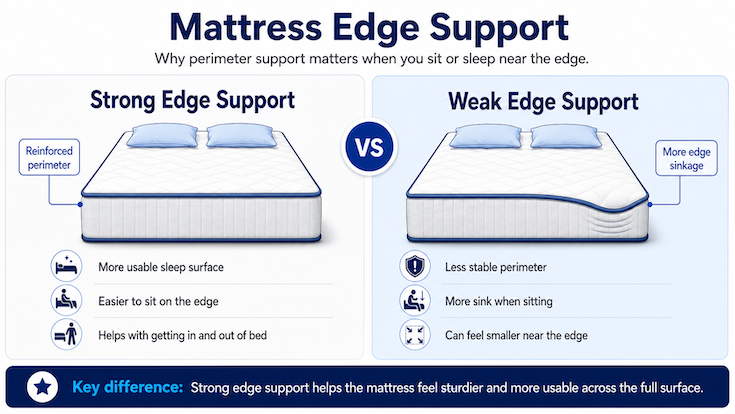
When a mattress has strong edge support, the sides stay stable. You can sit on the edge to tie your shoes without the corner collapsing, and you can sleep close to the side without feeling like you might roll off. When edge support is weak, the perimeter compresses much more than the center, so the usable surface shrinks and the edge feels unreliable.
It is a real construction feature, not just marketing language. But it is also a trade-off rather than a universal must-have, which is why the next question matters more than the definition.
Why Edge Support Matters, and When It Doesn't
Edge support does a few specific jobs. Whether those jobs matter depends on how you actually use your bed.
- Usable sleeping surface.
A firm perimeter means the full width of the mattress is comfortable to sleep on. Weak edges effectively shrink the bed, because the outer strip feels unstable and you drift toward the center.
- Sitting on the edge.
Most of us sit on the side of the bed every day to dress, put on shoes, or set an alarm. A supported edge gives you a stable place to do that instead of sinking in at the corner.
- Stability getting in and out.
A solid edge gives you something steady to push against when you sit down or stand up. This is a convenience and stability benefit, not a medical or mobility fix, and it depends on other things too, including how high the finished bed sits off the floor.
- Durability.
The perimeter tends to do more work than the center, because that is where people sit and press down day after day. On many mattresses the edges soften and sag before the middle does, which is a common reason a bed starts to feel worn out. A reinforced edge helps the mattress hold its shape longer.
- Sharing a bed.
For couples, edge support is often the difference between two people comfortably using the whole surface and both crowding toward the middle.
Here is the honest other side: if you sleep alone and stay near the center, edge support is a low priority. You are unlikely to notice a soft perimeter, and filtering hard for it could steer you away from an otherwise great mattress or lead you to pay for a feature you will rarely use.
So before you treat edge support as a requirement, picture how you use the bed. If you share it, sit on it, or spread out to the sides, it belongs on your list. If you do not, you can weight it lightly and focus on feel and support in the center.
Who Benefits Most From Strong Edge Support
| If you are... | Edge support is... |
|---|---|
| A couple sharing a queen or smaller | A high priority (it protects your usable width) |
| Someone who sits on the edge daily | A high priority |
| A larger-bodied sleeper | A high priority (more weight near the edge needs more resistance) |
| Focused on a steady surface for getting in and out | Worth prioritizing, alongside bed height |
| A solo sleeper who stays in the middle | A low priority |
Which Mattresses Actually Have Edge Support
This is the part most explainers skip. Once you know edge support matters for you, the real question is how to buy for it, and that comes down to construction. As a rule, coils hold an edge better than foam, because steel springs push back and rebound faster than foam does under a sharp load like someone sitting down.
| Mattress Type | Edge Support | Why |
|---|---|---|
| Hybrid | Strongest | Coil support core plus a reinforced perimeter, often thicker edge coils wrapped in a firm foam wall |
| Innerspring | Strong | Coils run to the perimeter, frequently with heavier edge coils or a steel border rod for rigidity |
| Latex | Moderate | Naturally resilient and springier than memory foam, so it resists collapse better, but it is still foam, not steel |
| Memory foam / all-foam | Weakest by default | Foam compresses the same at the edge as in the center, so the perimeter gives way unless it is reinforced |
A few construction terms are worth knowing, because they are how good edge support is built and how it shows up in product descriptions:
- Foam encasement.
A wall of firm, dense foam wraps around the coil unit. This is one of the most effective approaches and is common on quality hybrids.
- Reinforced or perimeter coils.
Thicker, firmer coils along the border resist sinking more than the coils in the center.
- Border rods.
Steel rods run around the edge of a traditional innerspring to keep the perimeter coils from folding.
- High-density foam rails.
In an all-foam mattress, firmer, denser foam along the sides is what stands in for coils. Denser perimeter foam generally holds up better, though density is one clue among several rather than a guarantee.
How to shop for it: if edge support is a priority, start with hybrid and innerspring mattresses, and look for language like foam encasement or reinforced edges. If you prefer the deep, contouring feel of an all-foam bed, it is still possible to get decent edges, but you will want to confirm the mattress is built with a reinforced or high-density perimeter rather than uniform foam.
For a closer look at how these materials feel overall, our memory foam vs. hybrid comparison walks through the construction and feel differences in depth, and you can browse the constructions that carry edge support best in our hybrid mattress collection and innerspring mattress collection.
What Most Edge-Support Guides Skip
The basics above will serve most shoppers well. A few less obvious points are worth knowing so you are not surprised later.
A reinforced edge can feel firmer than the middle. The same materials that hold an edge, dense foam rails or heavier coils, are firmer than the softer comfort layers in the center. On many mattresses the perimeter is deliberately more supportive than the sleep zone. That is usually a good thing, but if you tend to sleep right at the edge, be aware the outer strip may feel a little firmer than the spot you tested in the middle. It is worth lying near the side, not just the center, when you try a bed.
"Reinforced edge" on a spec sheet is a signal, not proof. Edge support depends on details a label rarely tells you: how dense the foam is, how thick the border coils are, how much comfort layer sits on top, and how much you weigh. Two mattresses can both claim reinforced edges and perform very differently. Treat the spec as a reason to shortlist a mattress, then confirm it in person.
Sometimes it is the base, not the mattress. If an edge feels like it is collapsing, the cause is not always the mattress. Widely spaced slats, a bowed foundation, or a bed frame that flexes can all make a perfectly good edge feel unsupported. Before you replace a mattress over its edges, check what is underneath it.
Edge support is not the same as firmness. A firm mattress can still have weak edges, and a softer mattress can have strong ones. Overall firmness is about how the surface feels under you; edge support is specifically about how the perimeter holds up. If firmness is also on your mind, our mattress firmness guide covers that separately.
How to Test Edge Support Before You Buy
Because construction only narrows the field, the most reliable way to judge an edge is to try it, ideally on the exact mattress and size you are considering. This is where shopping in person has a real advantage over ordering online sight unseen, and it is where Mancini's Sleepworld's 50-plus Northern California locations earn their keep: you can sit and lie along the edge of the exact mattress, with a Sleep Specialist to point you toward the sturdier perimeters. Test the behavior that matches how you actually use the bed:
- Sit on the edge.
Sit on the side the way you would to get dressed. A supported edge holds you up with only a little give. A weak one sinks sharply and feels like it might tip you off.
- Lie near the edge.
Lie down in your usual sleep position close to the side, not in the center, for a minute or two. Notice whether you feel stable and supported or like you are sliding toward the middle.
- Stand up from it.
If steadiness getting in and out matters to you, push off the edge and stand the way you normally would, and pay attention to the finished height of the bed as well.
Do this on the actual model on an appropriate base, not a firmer sibling or a different showroom setup, since both change how the edge feels.
If you would rather narrow the options before you visit, our SleepMatch quiz helps match you to mattresses that fit your preferences, and you can find your nearest Mancini's Sleepworld location to try the edges in person with help from our Sleep Specialists.
Finding a Mattress With the Right Edge Support
Edge support is one feature among several, and the goal is to weight it correctly for you rather than chase it for its own sake. Decide how much it matters based on whether you share the bed, sit on it, or sleep toward the sides. If it is a priority, start your search with hybrids and innersprings and look for reinforced perimeters. Then confirm the edge in person before you buy.
To keep exploring, browse our full range of mattress types or see what other shoppers are choosing in our top-reviewed mattresses. When you are ready to narrow it down, take the SleepMatch quiz or visit a store to feel the difference an edge makes.
FAQs
By default, all-foam memory foam mattresses have the weakest edge support, because foam compresses about the same at the perimeter as it does in the center. Some are built with firmer, high-density foam rails around the sides to reinforce the edge, so it is possible to get a memory foam bed with a stable perimeter.
If edge support matters to you, look for that reinforcement specifically, or consider a hybrid that pairs foam comfort layers with a coil support core.
Not much. If you sleep by yourself and stay toward the center of the bed, a soft perimeter is unlikely to bother you, so edge support is a low priority. You can focus your decision on the feel and support in the middle of the mattress instead.
Edge support becomes far more important when you share a bed, use the full width, or regularly sit on the side.
No. Firmness describes how the whole surface feels under your body, while edge support describes how well the perimeter specifically resists sinking. A firm mattress can still have weak edges, and a plush mattress can have well-reinforced ones. They are separate features, so it is worth evaluating each on its own.
It can help. The perimeter tends to take more wear than the center, since that is where people sit and press down every day, and on many mattresses the edges soften before the middle does.
A reinforced edge helps the mattress hold its shape and keep its full usable surface for longer, which is one reason edge support is worth considering even if you do not sleep near the sides.
Not in a meaningful way. Edge support is built into the mattress, so there is no reliable add-on that recreates a reinforced perimeter.
What you can do is rule out the base: make sure your foundation is solid, your slats are closely spaced, and your frame is not flexing, since those can make a good edge feel worse than it is.
If the mattress edges themselves have broken down, check the warranty first (sagging past a defined depth may be covered), and if not, that usually points toward replacement.