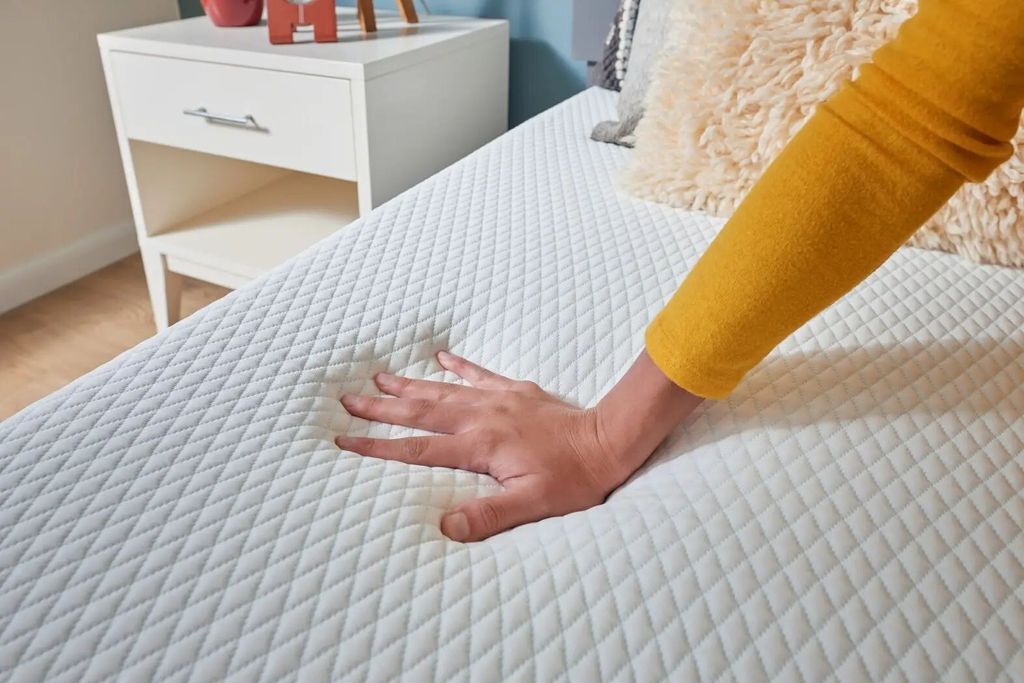

Firmness labels aren't standardized. There's no industry-wide measurement for mattress firmness in the United States. A mattress labeled "luxury firm" at one brand may feel like another brand's "medium-firm." A "medium" rating from one company can sit at a different point than the same label from another.
Table of Contents
- Why Firmness Labels Aren't Reliable on Their Own
- Body Weight Changes the Answer More Than Position Does
- How Material Changes the Firmness Experience
- How to Test Firmness Before You Commit
- If You're Shopping in Northern California
Body weight changes the answer more than most firmness charts admit. A mattress rated "medium" feels firm to a 110-pound sleeper and soft to a 230-pound sleeper. The difference is enough to put one in proper spinal alignment and the other out of it.
The three variables that determine the right firmness for your body: your weight, your sleep position, and the material delivering the firmness.
Why Firmness Labels Aren't Reliable on Their Own
The firmness scale most retailers cite (Soft, Medium, Firm, Extra Firm, sometimes expressed as 1 to 10) is a vocabulary brands use to describe their products. It's not a fixed measurement. The problems show up three ways:
- Brand-to-brand differences. What one brand labels "medium-firm," another calls "luxury firm," a third calls "cushion firm." Comparing a "6 out of 10" from Brand A to a "6 out of 10" from Brand B isn't comparing equivalent products. It's comparing two subjective scales overlaid on different materials and constructions.
- The clustering effect. Most sleepers prefer firmness in the 5 to 7 range (medium to medium-firm), so most brands target that band. Two mattresses both labeled "medium" can sit at different points within that compressed range.
- Temperature sensitivity. Memory foam softens with body heat. A medium foam mattress that feels firm in a cool 68°F store can feel noticeably softer once it warms to body temperature after 30 minutes. Latex stays consistent across temperatures. A quick in-store test on memory foam doesn't reliably represent how it feels during sleep.
Labels are useful for narrowing from "all mattresses" to "roughly the right zone." They're not an answer. The real work is figuring out which point in that zone fits your body.
Body Weight Changes the Answer More Than Position Does
The single biggest factor mainstream firmness charts underweight is body weight. Here's why.
A mattress has two functional layers: a comfort layer on top (typically 2 to 4 inches of foam, latex, or fiber) and a support core underneath (typically coils or high-density foam). The comfort layer compresses under your body. The support core stops the compression.
What happens at different body weights. Every mattress has a body weight at which the comfort layer fully compresses and the sleeper hits the support core directly. Below that weight, the firmness label describes the experience accurately. Above it, the label is misleading because what you're feeling is the support core, not the comfort layer the label was describing.
- A 130-pound side sleeper on a medium mattress sinks about 1 to 2 inches into the comfort layer. The support core barely engages. They experience the surface feel the "medium" label describes.
- A 250-pound side sleeper on the same mattress sinks 3 to 4 inches. The comfort layer fully compresses. They're resting on the support core. The mattress doesn't feel "medium" to them. It feels firm, then eventually bottoms out.
Are you a side sleeper shopping for a new mattress? Check out our guide to the Best Mattresses for Side Sleepers
Standard firmness recommendations are calibrated to roughly 130 to 180 pounds. If you fall outside that range, adjust:
| Body Weight | How to Adjust |
|---|---|
| Under 130 lb | Go one level softer than the standard chart suggests. The comfort layer engages less, so a mattress feels firmer to you than its rating implies. |
| 130 to 230 lb | Standard recommendations apply as written. |
| Over 230 lb | Go one level firmer than the chart suggests. The comfort layer compresses more deeply, so a mattress feels softer than rated. Firmer construction with denser comfort layers also holds its shape longer under repeated compression. |
The Position-Adjusted Firmness Matrix
Position narrows the range. Weight adjusts within it. Use this as a starting point:
| Position | Under 130 lb | 130 to 230 lb | Over 230 lb |
|---|---|---|---|
| Side | Soft to Medium-Soft (3 to 4) | Medium (5 to 6) | Medium-Firm (6 to 7) |
| Back | Medium-Soft (4 to 5) | Medium-Firm (6) | Firm (7) |
| Stomach | Medium-Firm (5 to 6) | Firm (7 to 8) | Firm to Extra Firm (8) |
| Combination | Medium (5) | Medium to Medium-Firm (5 to 6) | Medium-Firm to Firm (6 to 7) |
Why position matters: Side sleepers concentrate weight at the shoulder and hip (narrow contact zones that need cushioning to stay aligned). Back sleepers distribute weight more evenly and need the lumbar curve supported without the hips sinking. Stomach sleepers need firmness to keep hips from dropping below shoulders, which compresses the lower back. Combination sleepers need the mattress to work across multiple positions, which favors the middle of the range and faster-responding materials.
Couples with Different Body Weights
A 120-pound partner and a 200-pound partner have firmness ranges that may not overlap on a single shared mattress. Two options:
- Split-firmness mattress (each side has its own firmness profile). Cleanest solution.
- Heavier partner's firmness as baseline, with a topper on the lighter partner's side to soften it. Practical compromise.
If the weight gap is more than about 40 pounds, expect to compromise more than the matrix suggests.
Firmness and Durability Are Connected
A medium mattress used by a 250-pound sleeper for several years can develop body impressions and effectively become a soft mattress over time. The same mattress used by a 150-pound sleeper holds its rated firmness much longer.
Heavier sleepers are guided to firmer mattresses with denser comfort layers not because they need a "firmer feel" in the abstract, but because the firmer construction resists wear longer. The How Long Should a Mattress Last guide covers how materials degrade and what predicts lifespan.
How Material Changes the Firmness Experience
Two mattresses at the same firmness rating can feel different depending on what they're made of:
| Material | How "Medium" Feels | Speed | Best For |
|---|---|---|---|
| Memory Foam Mattresses | Slow contouring, sinking sensation. Body heat softens the foam over 30 seconds to several minutes. Deeper into the night, it feels softer than it did when you first lay down. | Slow recovery | Side sleepers who want deep contouring. Motion-sensitive couples. |
| Latex Mattresses | Responsive contouring with pushback. Conforms to body shape almost instantly without the slow-sink character. Temperature-consistent. | Fast recovery | Combination sleepers. Hot sleepers. Durability priority. |
| Hybrid Mattresses (pocketed coils + foam) | Zone-specific response. Coils under the hip respond differently than coils under the shoulder. Sits between foam and latex in feel. | Medium to fast | Most general cases. Combination sleepers. Couples. |
| Innerspring Mattresses (linked coils) | Uniform bounce. Less contouring than the other three. Cooler airflow. | Fast | Hot sleepers who don't need deep contouring. Budget priority. |
Why same firmness feels different across materials: Memory foam absorbs your movement slowly (you sink in gradually). Latex bounces back almost immediately (you feel supported on top of it rather than cradled inside it). Coils distribute your weight mechanically across a spring network. Same firmness number, three very different sleeping experiences.
How to Test Firmness Before You Commit
Labels and matrices get you to a shortlist. Testing confirms the answer. These protocols work at any retailer:
| Your Position | What to Do | What You're Looking For |
|---|---|---|
| Side | Lie on your side for 5+ minutes. Have someone photograph your spine from behind, or ask the store staff to check. | Spine forms a straight horizontal line. Hips hiked up = too firm. Hips dipping below waist = too soft. |
| Back | Lie on your back. Slide your hand under the small of your back. | Some contact, hand slides in and out. Big gap = too firm (lumbar unsupported). Hand can't get under at all = too soft (hips sinking). |
| Stomach | Lie face down. Pay attention to where your hips sit relative to your shoulders. | Hips and shoulders on the same plane. Hips lower than shoulders = too soft. |
| Combination | Do the elbow rebound test: press your elbow firmly into the mattress for a few seconds, lift, count how long it takes to return to flat. | Under 2 seconds = good for position changes. Over 5 seconds = you'll fight the surface every time you shift. |
Spend real time. 10 to 15 minutes minimum in your actual sleep position, not sitting on the edge, not lying on your back if you sleep on your side. Memory foam needs at least 5 minutes to warm to body temperature and show you its real feel.
Three signs the firmness is wrong (whether you tested it or not):
- Waking with hip or shoulder pain that resolves within 30 minutes of getting up (likely too firm at your contact zones)
- A "hammock" feeling in the lower back, hips sinking deeper than shoulders (likely too soft)
- Difficulty changing positions during the night because the surface doesn't recover fast enough (material mismatch, not just firmness)
If any of these show up in the first few weeks after purchase, use the comfort guarantee window most retailers offer to re-evaluate before the break-in period ends.
Pressure-mapping tools like SleepMatch add objective data to subjective testing: they measure your body's actual pressure distribution against a surface and show which zones are under-supported or over-compressed. Useful as a second data point if the in-store tests leave you uncertain.
If You're Shopping in Northern California
Any of our 50+ Mancini's Sleepworld mattress store locations in the San Francisco Bay and Sacremento Area can help you test across firmness zones in person. SleepMatch uses sensors to analyze your pressure points and body contours in about three minutes, which adds objective data to the subjective feel of lying on a mattress. SleepMatch doesn't assess temperature preference or motion isolation, so it's one input into the decision, not the whole picture.
Sleep Specialists are available in-store to help work through the decision in person. You can test memory foam, hybrid, and latex mattresses from brands like Tempur-Pedic, Casper, and Avocado side by side in the same store, which makes the firmness-across-materials comparison practical rather than theoretical. The Comfort Guarantee covers the break-in period, and free delivery is included on orders $499+ with old mattress removal.
If you're shopping online or outside Northern California, the weight-adjusted matrix and testing protocols above work with any retailer's product line.
Category pages filter by firmness level: Soft, Medium, Firm, Extra Firm.
Related Guides
- Mattresses for Back Pain and Mattresses for Pressure Relief. Condition-specific applications of firmness choice.