Adjustable Bed Base Guide: Benefits, Features, and How to Choose
Published: June 15th, 2026

How to Decide if an Adjustable Base Is Right for You
An adjustable base raises and lowers the head and foot of your bed, so you can read, watch TV, take pressure off your lower back, or elevate your legs without stacking pillows. The part most buying guides skip is the part that actually decides whether you'll be happy: not every mattress works on one, and a few of the "features" on the spec sheet matter far more than the rest.
Table of Contents
- What an Adjustable Base Actually Does
- Is an Adjustable Base Worth It for You?
- The Features That Matter (and the Ones That Don't)
- Will Your Mattress Work on an Adjustable Base?
- Sizing: Why Couples Should Look at Split King
- What to Verify Before You Buy
- Try It, Then Choose
- Frequently Asked Questions
This guide covers what an adjustable base does, the features worth paying for, whether your mattress is compatible, and what to check before you buy.
The short version:
- What it is:
a powered foundation that articulates at the head and foot; you control it with a remote or app.
- Who it suits:
readers and TV-watchers, people who snore or want their head elevated, anyone who likes legs-up comfort, and couples who can't agree on one position.
- The features that matter most:
independent head-and-foot articulation, programmable presets (including a one-touch flat), and enough weight capacity for your setup. Massage, lighting, and USB ports are nice, not decisive.
- The catch most guides bury:
your mattress has to be flexible enough to bend with the base. Memory foam, latex, and pocketed-coil hybrids work; a traditional innerspring usually doesn't.
- For couples:
a Split King gives each side its own base and its own controls.
Not sure where to start? SleepMatch matches you to a feel and setup in a few minutes, online or in any of our stores.
What an Adjustable Base Actually Does
An adjustable base sits where your box spring or foundation would normally go. Instead of lying flat, it bends: the head section raises so you're propped up, and the foot section raises so your knees and legs lift. A motor drives the movement, and you set the angle with a remote (most newer bases add an app). Everything else an adjustable base offers is built on those two motions.
The positions people use most:
- Head up.
Props you up for reading, working, or watching TV without a tower of pillows behind your back. A raised head also keeps the airway more open, which is why people who snore often sleep with the head section slightly elevated. Many find it eases nighttime acid discomfort for the same reason, since gravity keeps things settled.
- Legs up.
Lifting the legs takes load off the lower back and can ease the puffy, heavy feeling in the feet and ankles after a long day on your feet.
- Zero gravity.
A preset that raises both the head and the knees so your weight spreads evenly and your legs sit slightly above your heart. It's the position most people describe as the "floating" feeling, and it's usually a single button.
A note on how we'll talk about all of this: an adjustable base is a comfort and positioning tool. It can make reading easier, help you find a position where you snore less, or take pressure off your back. It is not medical equipment and won't treat or cure a condition. If you're dealing with a health issue, the base is something that may make you more comfortable, not a substitute for talking to your doctor.
For the deeper mechanics of how the motor, frame, and remote work together, our How Do Adjustable Beds Work? explainer goes further than we will here.
Is an Adjustable Base Worth It for You?
The honest answer is that it depends on how you spend time in bed and who you share it with. An adjustable base earns its price for some sleepers and is a pricey luxury for others. Here's how to tell which you are.
| If you... | An adjustable base is... |
|---|---|
| Read, work, or watch TV in bed | A strong fit. Replaces the pillow pile with real, adjustable back support |
| Snore, or like sleeping with your head raised | Worth a look. Head elevation is the single most-used position |
| Get leg or lower-back relief from putting your feet up | A strong fit. Legs-up is hard to replicate on a flat bed |
| Share the bed with a partner who wants a different position | Worth it in a Split King. Each side moves on its own |
| Sleep flat, lights-out, and never prop up | Probably not worth the premium. You'd pay for motion you won't use |
If you landed in the "strong fit" rows, the next two sections (features and mattress compatibility) are where the real buying decisions are. If you're still weighing the case in general, Are Adjustable Beds Worth It? makes the broader argument; this guide assumes you're leaning yes and want to choose well.
The Features That Matter (and the Ones That Don't)
Adjustable-base spec sheets are long on purpose, because a long list looks like value. In practice, a handful of features change how the bed feels every day, and the rest are conveniences you'll either use or forget. Sort them before you shop so the upsell doesn't sort them for you.
The features worth prioritizing:
| Feature | Why it matters | Priority |
|---|---|---|
| Independent head & foot articulation | The core function. Being able to set the head and the legs separately is what makes every position possible. | Essential |
| Programmable presets | One-touch return to your positions (zero gravity, reading) plus a flat button to get out of bed easily. You'll use these daily. | Essential |
| Weight capacity | The motor has to move your mattress plus you (and a partner). Under-spec'd capacity means slow, straining motors and a shorter life. Check it against your real setup. | Essential |
| Wall-hugging design | Keeps your nightstand reachable by sliding the base back as the head rises, instead of pushing you away from the wall. | High, if space is tight |
| Independent (split) sides | For couples: each person sets their own angle. The reason to buy a Split King. | High, if you share |
The features that are nice, not decisive:
- Massage.
A gentle vibration in the head and foot sections. Pleasant, and some people love it for winding down, but it doesn't change how you sleep. Buy it if you want it; don't let it drive the decision.
- Under-bed lighting, USB ports, app control.
Genuinely convenient (a soft light for a 2 a.m. trip, a charger within reach), but they don't affect comfort or support. Treat them as tiebreakers between two bases you otherwise like equally.
- Preset count.
Three useful presets beat ten you'll never program. More isn't better here.
What this means for you: decide which of the three essentials you actually need before you walk in, and you'll spot the difference between a base that's priced for its motors and frame and one that's priced for a feature list you won't use. The reading-and-relief features are the bed; the lighting and ports are the trim.
Will Your Mattress Work on an Adjustable Base?
This is the question most listicles skip, and it's the one that voids warranties and ruins mattresses when it's missed. An adjustable base only works if the mattress on top can bend with it. Some can; some can't.
| Mattress type | Works on an adjustable base? | Why |
|---|---|---|
| Memory foam | Yes, the best match | Flexible all the way through; bends with the base without lifting off or cracking inside |
| Latex | Yes | Pliable and durable; softer latex flexes more easily than very firm latex |
| Hybrid | Usually, if it uses pocketed coils | Individually wrapped coils move independently, so the mattress flexes; check the spec |
| Traditional innerspring | Usually not | Connected coils and a stiff perimeter wire resist bending; they can deform or strain the motor |
Why a traditional innerspring is the problem child. Two things make a standard innerspring fight the base. First, most have a thick border wire running around the perimeter for edge support; force it to bend night after night and it can permanently kink (ruining the mattress) or jam the base's motor. Second, older coil designs link the springs together (a connected "Bonnell" coil system), so the whole sleep surface is rigid and can't follow the base's angles. Pocketed-coil hybrids dodge both problems because each coil is wrapped and moves on its own, which is why a hybrid can work where a classic innerspring can't.
Thickness matters too. Aim for a mattress in the 8-to-14-inch range; roughly 10 to 12 inches is the sweet spot. Go much thicker and the mattress can be too stiff to articulate cleanly, which strains the motor and leaves gaps at the bend.
What this means for you: before you fall for a base, confirm your mattress is foam, latex, or a pocketed-coil hybrid in a workable thickness, or plan to replace it. Two safe shortcuts: buy the base and mattress as a matched set so compatibility is handled for you, and check the mattress warranty, because some makers require an "adjustable-friendly" foundation and using the wrong one can void coverage.
If a new mattress is part of the plan, our memory foam and hybrid collections are the two types most at home on an adjustable base, and Memory Foam vs. Hybrid lays out the trade-off between them. You can also browse our adjustable bed sets, where the base and a compatible mattress are paired together, to take the guesswork out entirely.
Sizing: Why Couples Should Look at Split King
Adjustable bases come in the standard sizes (Twin XL, Full, Queen, King) plus one configuration built specifically for two: the Split King.
A Split King is two Twin XL bases (and two Twin XL mattresses) side by side, which together match a King's footprint of 76 by 80 inches. Because each half is its own base with its own remote, one partner can raise their head to read or to snore less while the other stays flat, or one can run legs-up while the other sits upright. On a single King base, both sides move together; on a Split King, they don't. For couples who never agree on a position, that independence is usually the whole reason to buy.
The trade-off is bedding: a Split King is two mattresses with a seam down the middle, so couples typically use a King flat sheet over the pair and separate fitted sheets, or a split-top King set made for exactly this.
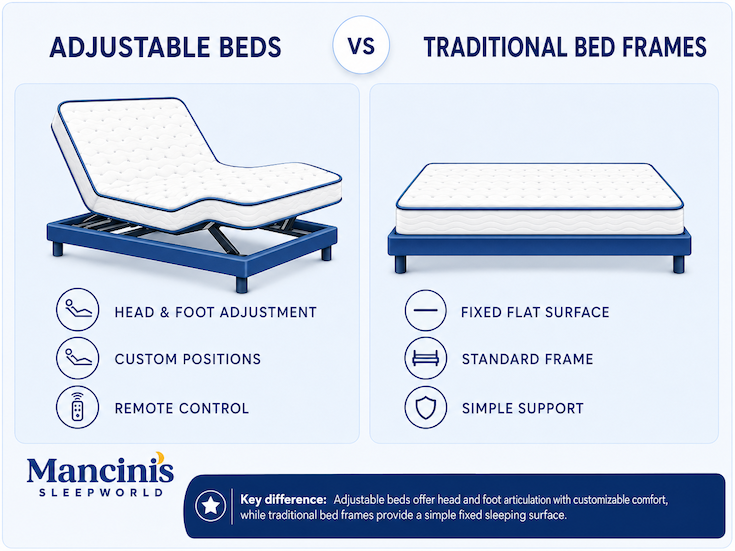
If you want a deeper read on King-class sizing, our King vs. California King comparison covers the footprint differences. For how the comparison shakes out against a plain platform or frame, see Adjustable Beds vs. Traditional Frames.
What to Verify Before You Buy
Once you know an adjustable base fits how you sleep, a short pre-purchase checklist keeps you from the avoidable surprises. Run through it before you commit.
- Mattress compatibility and warranty.
Confirm your mattress is foam, latex, or pocketed-coil hybrid in a workable thickness, and that an adjustable base won't void its warranty. This is the big one; see the compatibility section above.
- Will it fit your frame?
Many bases drop right into an existing modern bed frame, but the frame needs an open inside (a slatted or platform design), not a solid center beam or low side rails that block the base from bending. Measure the inside of your frame against the base's outside dimensions; the base should sit slightly smaller. Some bases are designed to be used on their own legs, with or without a frame around them.
- Weight capacity for your real setup.
Add up the mattress, the base, and the people, and make sure the spec clears it with room to spare. Under-spec'd motors move slowly and wear out early.
- A retainer bar or bracket.
When the head raises, an unsecured mattress can creep. Most quality bases include a foot retainer bar or brackets to hold the mattress in place; confirm yours does.
- The power-outage plan.
Look for a manual or battery-backup lowering option so you're never stuck in an elevated position if the power drops. It's a small spec that matters the one time you need it.
- Motor noise.
The base will run while someone's trying to sleep. Quieter motors are worth the in-person test, which is the best argument for trying one before you buy.
What this means for you: the two checks that save the most regret are mattress compatibility and frame fit. Get those right and the rest are refinements. The easiest way to clear the whole list at once is to see the base in person, on a compatible mattress, and run it through its positions yourself.
Try It, Then Choose
A spec sheet can tell you a base has a zero-gravity preset and a 750-pound capacity. It can't tell you whether the reading angle feels right for your back or whether the motor is quiet enough for your partner. That's the part worth doing in person.
Take the SleepMatch quiz for a personalized starting point (your feel, your position needs, and a mattress that pairs with an adjustable base) in a few minutes, online or in store. Or visit any of our 50+ Mancini's Sleepworld locations across Northern California to lie down, raise the head and the legs, find zero gravity, and feel the difference before you decide. New adjustable bases and mattresses $499 and up qualify for free local delivery, and Synchrony financing offers 0% for 12, 18, or 24 months on qualifying purchases, subject to credit approval.
When you're ready to compare models, start with our adjustable foundations and adjustable bases collections.
FAQs
Maybe; it depends on the type. Memory foam, latex, and hybrid mattresses with individually pocketed coils are flexible enough to bend with the base.
A traditional innerspring mattress with connected coils and a stiff perimeter wire usually isn't, and forcing it can damage the mattress or strain the base's motor. Aim for a mattress in the 8-to-14-inch range, and check the mattress warranty, since some require an adjustable-friendly foundation.
The three that change daily comfort are independent head-and-foot articulation, programmable presets (including a one-touch flat to get out of bed), and enough weight capacity for your mattress plus the people in the bed.
Wall-hugging design matters if your nightstand is close. Massage, under-bed lighting, and USB ports are conveniences: nice to have, but not reasons to choose one base over another.
Yes. The Split King is built for two: it's two Twin XL bases side by side, matching a King's 76-by-80-inch footprint, with each side moving independently on its own remote.
That lets one partner elevate their head while the other lies flat. Adjustable bases also come in Twin XL, Full, Queen, and standard King, but only the Split King gives each person separate control.
Zero gravity raises both your head and your knees so your body weight spreads evenly and your legs sit slightly above your heart, creating a relaxed, weightless feeling. Most adjustable bases offer it as a one-touch preset. It's popular for unwinding and for taking pressure off the lower back, framed as comfort and positioning rather than a medical treatment.
Often, if the frame has an open inside: a slatted or platform design without a solid center support beam.
Measure the inside of your frame and compare it to the base's outer dimensions; the base should sit slightly smaller.
Frames with solid foundations, full-length center beams, or low side rails usually aren't suitable. Many bases can also stand on their own legs, with or without a surrounding frame.
Sleeping with the head section raised keeps the airway more open and uses gravity to keep things settled, which is why many people find an elevated head reduces snoring and nighttime discomfort.
It's a comfort and positioning benefit, not a medical treatment. If you have a diagnosed condition like sleep apnea or chronic reflux, talk to your doctor about whether elevation fits into your plan.
Read more about it in our guide on The Link Between Your Mattress and Acid Reflux Symptoms.