Adjustable Beds vs. Traditional Frames: Which One Improves Your Sleep?
Published: April 29th, 2026

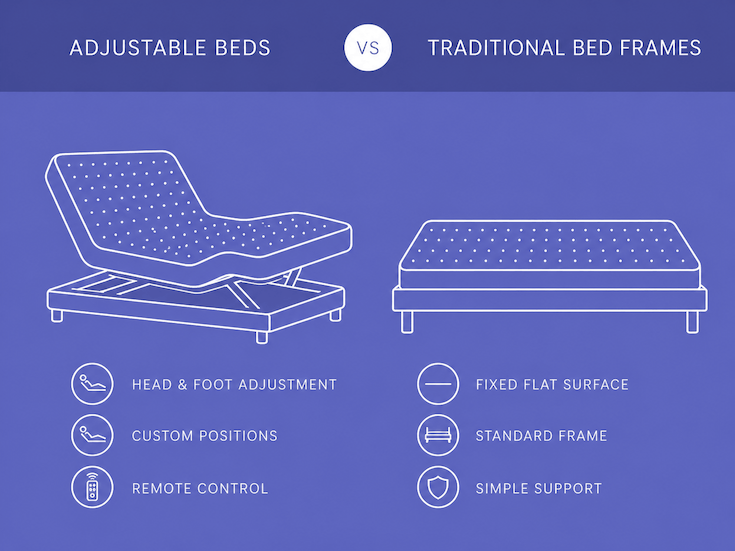
Adjustable bases help specific conditions at specific angles. For diagnosed sleep apnea, chronic GERD, or daily mobility limitations, the elevation capability produces measurable improvement backed by clinical data. For healthy sleepers without those symptoms, the same $1,500 to $3,000 produces more benefit applied to mattress quality than to an adjustable base.
Table of Contents
- Who Should Get an Adjustable Bed (and Who Shouldn't)
- Mattress Compatibility: The Constraint That Changes the Cost
- What You'll Actually Use (and What You Won't)
- Quick Decision Reference
- If You're Shopping in Northern California
Three filters determine which category you fall into:
- Condition match. Whether your situation lines up with a research-supported elevation threshold. Elevation without a corresponding condition is decoration. The clinical data is specific: 7.5° for apnea, 6 to 8 inches for GERD, 15 to 20° leg raise for lower back relief.
- Mattress compatibility. Whether your current mattress can flex repeatedly without damage. If it can't, you're buying a base AND a new mattress, which can double the total cost from $1,500 to $3,000 to $3,000 to $6,000.
- Feature usage after month three. Whether you'll use the adjustment features daily or forget them after the novelty fades. Most buyers find one preferred angle within the first month and use only that position going forward. A $400 to $1,000 base captures most of the daily utility the $3,000 base does, unless specific premium features match a specific use case.
Who Should Get an Adjustable Bed (and Who Shouldn't)
1. Diagnosed Sleep Apnea or Persistent Snoring
When an adjustable base is justified:
- Diagnosed mild-to-moderate obstructive sleep apnea. A study of 52 patients found 7.5° head elevation reduced severity by about a third (apnea events dropped from roughly 16 to 11 per hour). An adjustable base holds this angle nightly without pillow stacking.
- Persistent loud snoring disrupting your partner. A pilot study of 22 subjects found 67% of snoring episodes interrupted at 20° elevation versus 22% at 10°. Small study, so treat as suggestive rather than definitive. Some adjustable models include automatic anti-snore detection that raises the head slightly when snoring is detected.
When a traditional frame is fine:
- Occasional snoring that doesn't disrupt your partner. A $30 to $80 wedge pillow tests the same intervention at a fraction of the cost. If the wedge helps after a few weeks, the adjustable base is justified as the durable version. If it doesn't, the base won't either.
Important: For diagnosed apnea, an adjustable base complements CPAP therapy. It doesn't replace it. If you suspect apnea but don't have a diagnosis, a sleep study is the right first step before a $2,000+ purchase.
2. Chronic Acid Reflux or GERD
When an adjustable base is justified:
- Chronic nighttime reflux disrupting sleep regularly. Head elevation of 6 to 8 inches (15 to 20 cm) is the standard clinical recommendation, supported by a 2021 systematic review finding beneficial effects on GERD symptoms (with the caveat that underlying trial evidence is limited in size and quality). An adjustable base sets this elevation precisely and holds it through the night.
- Severe cases may benefit from a 35 to 45° angle, which is difficult to maintain with pillows or wedges alone.
When a traditional frame is fine:
- Occasional reflux (a few times monthly, mostly after specific foods). A wedge pillow plus dietary changes (no eating within 3 hours of bed, sleeping on the left side) is the standard first-line approach. If those don't resolve it, escalation to an adjustable base or a doctor consultation is the next step.
The deciding factor: An adjustable base earns its cost when reflux is frequent enough that nightly elevation is the routine, not an occasional accommodation.
3. Chronic Back Pain, Post-Surgery, or Mobility Limitations
When an adjustable base is justified:
- Chronic lower back pain improved by reclined positioning. The zero-gravity position (head 7 to 10°, legs raised 15 to 20°) reduces pressure on the lower back by distributing your weight more evenly. If your back pain improves noticeably in a recliner, that's a signal the zero-gravity position will help. If it doesn't respond to positional changes, the adjustable base is unlikely to help either.
- Post-surgery recovery. Cardiac, abdominal, and joint replacement recovery often requires elevation that's difficult to maintain without an adjustable base.
- Mobility limitations. The head-elevation feature becomes a daily functional aid for getting in and out of bed, not a sleep feature.
When a traditional frame is fine:
- Occasional back pain that's position-related or hasn't been evaluated medically. A mattress with appropriate firmness for your body weight and sleep position often produces more relief at lower cost than adding adjustment to the wrong mattress. A pressure-mapping assessment can help identify whether mattress fit is the underlying issue before you invest in a base.
4. Mismatched Partner Schedules or Regular In-Bed Activities
When an adjustable base is justified:
- Significantly different schedules (one works nights, one works days). A split-king adjustable lets each side adjust independently. The partner watching late-night TV can elevate without disturbing the partner asleep flat.
- Couples who spend substantial time reading or watching TV in bed get real daily value from head elevation that a flat frame can't provide.
When a traditional frame is fine:
- Aligned schedules, sleep flat naturally, limited in-bed time outside of sleep. The split-king dual-control premium ($400 to $1,000 above a single-king base) is hard to justify without daily use. If only one partner would use independent positioning, a single-side adjustable with the other side on a traditional frame is a cheaper option worth exploring.
5. Healthy Sleeper, No Specific Condition
No justified use case. A traditional frame is fine. The $1,500 to $3,000 premium produces no measurable change in sleep quality for this profile.
The same dollars produce more benefit applied to a higher-quality mattress (denser foam, better hybrid construction). The upgrade that matters most for healthy sleepers is the sleep surface, not the position.
If you're drawn to the idea, a $30 to $80 wedge pillow tests the concept. Two weeks of no change confirms the traditional frame is the right call.
Mattress Compatibility: The Constraint That Changes the Cost
Adjustable bases require a mattress that can flex repeatedly without damage. If your current mattress is incompatible, you're not buying a base alone.
| Mattress Type | Compatible? | Notes |
|---|---|---|
| Memory foam | Yes | Flexes easily with the base |
| Latex | Yes | Naturally flexible |
| Hybrid with pocketed coils | Yes | Pocketed coils flex independently |
| Innerspring designed for adjustable use | Sometimes | Rare. Check manufacturer spec. |
| Traditional innerspring (Bonnell / continuous wire) | No | Interconnected coils; repeated flexing damages springs and strains the base motor |
| Innerspring with border wires | No | Wires prevent bending and flat recovery |
| Attached or permanent box spring | No | Won't flex |
Thickness sweet spot: 8 to 14 inches works on most adjustable bases. Under 8 is too thin for adult sleep comfort. Over 14 resists bending and strains the motor. The 10 to 12 inch range is the practical target for most buyers.
Total system cost:
| Your Situation | What You're Buying | Typical Cost (Queen) |
|---|---|---|
| Compatible mattress, less than 7 to 10 years old | Base only | $1,500 to $3,000 (mid-tier features) |
| Incompatible mattress or mattress past its useful life | Base + new compatible mattress | $3,000 to $6,000 |
| Budget base, compatible mattress | Base only (head/foot adjustment, no premium features) | $400 to $1,000 |
This cost difference is one of the most common surprises for shoppers who expected to upgrade the base only. Your current mattress's age and construction is one of the first things to verify before committing. Browse adjustable foundations to see the full range of options and price points.
What You'll Actually Use (and What You Won't)
| Feature | Usage Reality | Worth It When |
|---|---|---|
| Head and foot adjustment | Used nightly by most buyers who match Scenarios 1 to 4 | Any condition-matched scenario. This is the core function. |
| Wireless remote with 1 to 2 presets | Used nightly. The practical interaction layer. | Always included. Not a premium differentiator. |
| Zero-gravity preset | Used regularly by buyers with back pain or circulation issues. Rarely used by healthy sleepers after the novelty fades. | Chronic back pain or circulation conditions. |
| Anti-snore preset | Used regularly by partners of snorers. Ignored without snoring as a daily concern. | Scenario 1 (diagnosed apnea or persistent snoring). |
| Massage | Varies dramatically. Some use it 5 to 10 minutes nightly. Others use it once. | Hard to predict. Not a reason to upgrade tiers on its own. |
| App controls | Most buyers default to the wireless remote because it's faster. | Rarely a reason to pay more. |
| Under-bed lighting | Useful for nighttime navigation. | Convenient when present. Not a deciding factor. |
| USB ports, Bluetooth speakers | Convenient when present. | Not a meaningful upgrade trigger. |
| Multiple programmable presets beyond 2 | Most buyers find one preferred angle and stay there. | Rarely needed. Two presets cover most use cases. |
The pattern worth noting: Buyers settle on one preferred elevation angle within the first month and use that angle for most nights. Factory presets (zero-gravity, anti-snore) are starting points for finding that angle, not positions used as labeled.
This means the $400 to $1,000 base with head and foot adjustment delivers most of the daily utility the $1,500 to $3,000 base does, for buyers who just need elevation.
The premium tier is justified when specific features (split-king dual controls, automatic anti-snore detection, regular-use massage) match a specific daily use case.
Quick Decision Reference
| Your Situation | Recommendation |
|---|---|
| Diagnosed mild-to-moderate sleep apnea (as CPAP complement) | Adjustable base justified |
| Chronic GERD or nightly acid reflux requiring regular 6 to 8 inch elevation | Adjustable base justified |
| Chronic back pain that improves in a reclined position | Adjustable base justified |
| Post-surgery recovery requiring elevation | Adjustable base justified |
| Mobility limitations affecting flat-bed entry/exit | Adjustable base justified |
| Significantly mismatched partner schedules with substantial in-bed time | Split-king adjustable justified |
| Borderline symptoms, unsure if elevation helps | Test with a $30 to $80 wedge pillow for 2 to 3 weeks first. If it helps, the base is the durable version. If it doesn't, the base won't either. |
| Current mattress is incompatible | Verify total system cost (base + mattress) before committing. The math changes significantly. |
| No diagnosed condition, no elevation-responsive symptoms, current setup works | Traditional frame is fine. Invest in mattress quality instead. |
If You're Shopping in Northern California
Any of our 40+ Mancini's Sleepworld locations carries adjustable bases across the full feature and price range, plus mattresses confirmed compatible with adjustable use. You can test a Casper, Nectar, or Tempur-Pedic on an adjustable base side by side in the same store, which is something most online-only retailers can't offer. Sleep Specialists are available in-store to help work through the decision in person.
SleepMatch uses sensors to analyze your pressure points and body contours in about three minutes. That data can help clarify whether the upgrade you need is the base, the mattress, or both. SleepMatch doesn't assess temperature preference or motion isolation, so it's one piece of the decision, not the whole picture.
The Comfort Guarantee covers the break-in period (sleep on it for at least 30 nights before deciding on an exchange), and free delivery is included on orders $499+, including old mattress removal.
If you're shopping online or outside Northern California, the scenario matching and compatibility checks above work with any retailer's product line. The diagnostic is portable.
Related Guides
- Are Adjustable Beds Worth It? Broader cost-benefit evaluation beyond the comparison frame.
- Best Mattresses for Adjustable Foundations If your current mattress is incompatible, start here.
- Five Benefits of Sleeping in Zero Gravity Position Deeper look at the zero-gravity position referenced in Scenario 3.