
Is a Split King Right for You and Your Partner? A Couple's Decision Guide
Split king gets marketed to couples as the fix for almost any disagreement about the bed. Sometimes it genuinely is the right call. Often a single mattress does the job for less money and less complication. This guide is built around one question: is a split king actually viable for the two of you, or are you about to solve a problem you don't have?
Before any of that, there's a question that comes first. If what's keeping one of you awake is a sleep disorder rather than a mattress mismatch, no configuration, split king included, will fix it. So we start there, then walk through the decision.
Table of Contents
- The Quick Read
- First, Rule Out a Sleep Disorder
- What a Split King Actually Is
- Is a Split King Viable for You? Five Signals
- When You Don't Need One
- Pick the Right Variant: Split King vs Split-Top vs Flex Top
- Choosing the Mattress for Each Side
- Before You Commit: Living With the Seam
- The Adjustable Base Question
- What a Split King Won't Fix
- How to Confirm Your Decision Together
The Quick Read
If you only read one section, read this one.
A split king is likely worth it if:
Your firmness preferences are two or more steps apart (for example, plush vs firm), not just adjacent.
One of you has a clinical reason for a specific firmness that the other doesn't share.
You differ in body weight by roughly 40 pounds or more.
You want fundamentally different mattress types, not just different firmness.
You probably don't need one if:
Your firmness preferences are the same or off by a single step.
You're similar in weight and want the same type of mattress.
Your real complaint is snoring, schedule mismatch, or restlessness from an unaddressed condition, in which case a mattress is solving the wrong problem.
The rest of this guide is how to pressure-test which side of that line you fall on.
First, Rule Out a Sleep Disorder
Run through these three questions together before you shop. If any returns a clear yes, your next conversation is with a clinician, not a Sleep Specialist, because a split king cannot address what's actually happening.
- Does the disturbing partner snore loudly with pauses in breathing, or wake up gasping?
This is a screening signal for obstructive sleep apnea. No mattress configuration addresses apnea; diagnosis and treatment (often CPAP) does.
- Does the disturbing partner have repetitive, stereotyped leg movements every 15 to 30 seconds during sleep?
This pattern is consistent with periodic limb movement disorder (PLMD), which affects an estimated 7 to 29 percent of adults depending on age. The movements are generated in the central nervous system, so a mattress surface can't damp them.
- Did one partner's strong firmness preference appear recently after an injury, pregnancy, or posture change?
A recent-onset firmness preference is often a symptom of an underlying musculoskeletal issue rather than a real change in preference. Treating the underlying issue frequently resolves the disagreement without any split mattress at all.
One more worth checking: if your current mattress is 7 to 10 years old or shows body impressions deeper than an inch and a half, the support layer may be breaking down asymmetrically and deepening a firmness mismatch that wouldn't otherwise exist. Before you conclude you need two different mattresses, it's worth reading our guide on when to replace your mattress.
What a Split King Actually Is
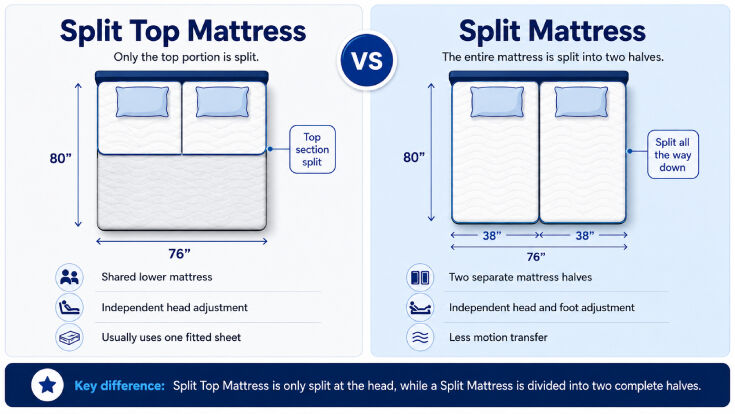
A split king is two twin XL mattresses, each 38 inches wide by 80 inches long, placed side by side. The combined footprint is 76 by 80 inches, the same as a standard king. Each side can be a different firmness, and split king is commonly paired with an adjustable base so each partner can raise or lower their head and foot independently.
That independence is the entire value proposition. A split king solves preference divergence between two people. It does not, by itself, make a mattress better, cooler, or more supportive than a single king. If you and your partner don't actually diverge, you're paying for flexibility you won't use.
Is a Split King Viable for You? Five Signals
Split king is a real product, not a gimmick, but it earns its place for a narrower group than the marketing suggests. The more of these that apply to you, the stronger the case.
- Your SleepMatch results diverge by more than one step.
If your color results (Red, Blue, Green, or Gold) come back more than one step apart, a single mattress can't serve both of you well. A Medium and a Medium-Firm can usually share one mattress at the closer of the two. A plush and a firm cannot.
- One of you has a clinical firmness requirement the other doesn't share.
Chronic back pain, hip bursitis, or post-surgical recovery can dictate a specific firmness. A 2003 Lancet randomized trial of 313 patients found medium-firm mattresses produced better outcomes than firm mattresses for chronic non-specific low-back pain. When one partner needs medium-firm for a condition and the other prefers plush, split king lets each side hit its target instead of forcing a compromise that serves neither.
- You differ meaningfully in body weight.
A common threshold is around 40 pounds. The lighter partner needs more give for pressure relief; the heavier partner needs more support. A single firmness oversupports one of you and undersupports the other.
- You want fundamentally different mattress types.
Not just different firmness, but different feel: one of you wants memory foam responsiveness, the other wants latex bounce. Split king accommodates this as long as both selected mattresses are adjustable-base compatible.
- Only one of you needs independent head elevation.
Reading in bed, snoring relief, or reflux can call for raising one head without disturbing the other. This is a real signal, but note that it usually points to a split-top king rather than a full split king. More on that distinction below.
If only that last point applies, skip ahead to the variants section before you commit to a full split. If none of the five apply, the next section is for you.
When You Don't Need One
This is the part most split king content skips, and it's the part that protects you from overspending. If your preferences are the same or adjacent, you're similar in weight, and you want the same type of mattress, a single king or California king in a medium-firm hybrid is almost always the better buy.
It's cheaper, it has no seam to manage, and the firmness it lands on is the best-supported choice for shared sleep. Medium-firm is the firmness most consistently backed across systematic reviews for general comfort and back health, which is why it's the default recommendation for couples who don't have a specific reason to diverge. A pocketed-coil hybrid then handles motion transfer at the coil layer while keeping the edge support and cooling that all-foam beds tend to sacrifice.
Adjacent SleepMatch colors still fit this path. If one of you lands on Green and the other on Blue, you can typically share a single mattress tuned to the closer firmness and never feel the difference. Split king becomes the answer only when the gap is genuinely too wide to bridge.
Pick the Right Variant: Split King vs Split-Top vs Flex Top
If you've decided a split is viable, the next step is choosing the right kind. These terms get used interchangeably and aren't the same product.
| Variant | Construction | What it solves | Adjustable base |
|---|---|---|---|
| Split king | Two full-length twin XL mattresses, fully independent | Different firmness per side plus independent head and foot articulation | Each side moves independently |
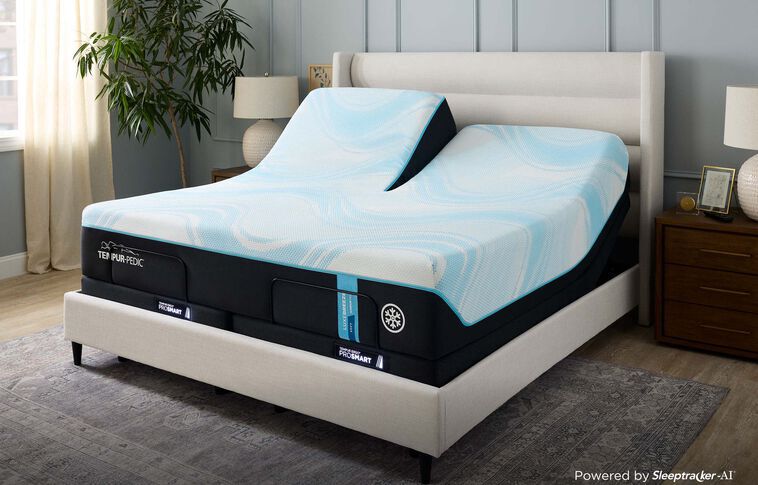
| Split-top king / flex top king | Single mattress with a split only at the top third | One partner elevates the head for reading or to ease reflux without separating the foot | Head articulates independently; firmness is shared |
| Standard king | Single mattress, no split | Shared sleep surface in one piece | Articulates as a single unit |
The shortcut: if your only need is independent head elevation, a split-top king with a single firmness is the cleaner choice and avoids the seam entirely. You need a full split king only when your firmness preferences genuinely diverge.
Choosing the Mattress for Each Side
Once you're committed to a full split, you're really making two mattress choices. A few rules keep the pairing coherent.
Hybrid is the safe default for each side. It balances motion isolation, responsiveness, edge support, and cooling better than all-foam for most sleepers. Unless one of you has a specific reason to go memory foam or latex, hybrid on both sides is the low-risk pick.
Match the heights. If you're pairing different types across sides, keep both mattresses within about an inch of each other in height. A larger difference creates a noticeable step at the seam.
Don't choose split king to solve motion transfer. A split king is about firmness independence, not primarily about motion. If motion is your main complaint, a pocketed-coil hybrid handles it without splitting at all. It's also worth knowing the research is mixed on how much partner motion actually matters: a 2020 study by Drews and colleagues, using overnight sleep monitoring on couples, found people spent about 10 percent more time in REM sleep when sleeping together than apart, despite more limb movement. In the researchers' phrasing, your body is a bit unrulier sleeping next to someone, but your brain is not. Motion isolation matters if one of you genuinely wakes when the other rolls over. It's not a reason to buy a split king on its own.
Know memory foam's tradeoffs before you pick it for a side. Memory foam ranks first for motion isolation because its slow recovery absorbs movement, but the same property creates the "stuck" feeling some sleepers dislike, retains more heat at higher densities, and weakens edge support. It also stiffens in cool rooms, so the showroom feel doesn't fully carry to a bedroom kept below about 65 degrees. That's why hybrid remains the default recommendation even on a split.
Before You Commit: Living With the Seam
The single most common regret with split king is the visible gap where the two mattresses meet. It's solvable, with caveats, and you should weigh it honestly before you decide. Four approaches:
- Foam bed bridge.
A foam strip (typically 75 to 78 inches long, 10 to 12 inches wide, 3 inches thick) laid across the seam under a fitted sheet system. Inexpensive and effective at first. Caveat: no manufacturer publishes durability data, no warranty covers the accessory, and the foam compresses over time. Expect to replace it.
- Dual-fitted sheet system.
Two twin XL fitted sheets plus a king-size flat sheet on top, which is how most split-king sheet sets ship. This is the standard approach for adjustable-base setups, where one piece of fabric over both sides would bunch during articulation.
- Firm-foam center panel.
Some mattresses are engineered with a firmer foam strip running down each twin XL's inner edge to reduce sinkage and gap perception. Worth asking about brand by brand.
- Migration retention.
The gap is widest when the mattresses drift outward over time. Non-slip silicone bottoms or micro-hook retention strips (Leggett & Platt sells these) hold the pair in place, which is especially useful on adjustable bases where articulation creates lateral force.
Most couples adapt to the seam within a few weeks. A subset never does. If you already dislike noticeable seams or gaps, assume you may be in that subset and weight a single king or a split-top king more heavily in your decision.
The Adjustable Base Question
Adjustable bases pair naturally with split king for independent articulation per side, and the upsell pressure on them is heavy across the industry. They're most valuable when you have a clear clinical reason to elevate part of the body: diagnosed positional sleep apnea, reflux, leg edema, or post-surgical recovery. If that's you, the spend is justified.
If a base is being offered as a general couples "enhancement" without that clinical fit, ask your Sleep Specialist directly whether it's adding decision value or just adding cost. Two practical cautions before you sign:
- The motor warranty is shorter than the headline number.
Leggett & Platt's standard adjustable-base warranty covers steel and mechanical components for years 4 through 25 but excludes drive motors and electronics after year 3. The 25-year figure covers the frame, not the parts that actually move.
- In a split configuration, you're buying two motor systems.
Dual articulation means two independent motors, each able to fail on its own. That's twice the mechanism, and the same limited warranty structure applies to both.
What a Split King Won't Fix
Matching the solution to the problem is the whole point of this guide, so a quick list of what a split king does not solve:
- Temperature mismatch between partners.
The more effective lever here is the bedding layer (separate duvets, breathable covers, climate control) rather than the mattress, because temperature performance varies more between specific mattresses within a type than between types. Worth noting: the belief that women always sleep hotter than men is partly wrong. 2024 PNAS research found women's thermoneutral zone actually shifts cooler than men's.
- Sleep disorders.
If any of the three diagnostic questions at the top flagged a signal, the next step is a clinician, not a mattress of any configuration.
- A schedule or restlessness mismatch from an unaddressed condition.
If you wake to your partner's snoring or 2 a.m. tossing rather than to a single roll-over, splitting the firmness won't change anything.
How to Confirm Your Decision Together
Two steps will tell you whether a split king is genuinely your answer.
Take SleepMatch together. Each partner takes the quiz independently, online or in any Mancini's Sleepworld location. The color-coded result captures each of your firmness profiles separately, running from Red (maximum support, firmer) through Blue and Green to Gold (less support, plush). If you both surface the same color, a single shared mattress is the cleanest answer. If you surface adjacent colors, you can usually share one mattress at the closer firmness. If you surface non-adjacent colors (Red and Green, or Blue and Gold), that's your signal to investigate split king seriously.
Visit a location together and test in your real sleep position. Lying down for 30 seconds tells you nothing. Plan 10 to 15 minutes per candidate, both of you present, in the position you actually sleep in. Have the heavier partner move and reposition normally while the lighter partner checks for transferred motion at hip level. That's a more honest motion test than any showroom demo with a wine glass.
With 50+ locations across Northern California, there's likely a store within a short drive. Free local delivery is included on purchases of $499 and up, and the Comfort Guarantee gives you a return window if the configuration you chose doesn't work once you've actually slept on it.
If you want to narrow options before you visit, our hybrid mattress collection is where most couples land, our memory foam collection is the path if motion is your dominant concern, and our adjustable foundations page covers the split-king-compatible base configurations.
FAQs
No. The FDA states that there are no federal standards or definitions governing "hypoallergenic," for cosmetics or mattresses. The term means whatever a manufacturer wants it to mean. The certifications above (GOTS, Greenguard Gold, MADE SAFE, OEKO-TEX, GOLS, CertiPUR-US) certify specific things and are independently auditable.
A full-mattress encasement with pore size below 6 microns isolates the existing population from the air; you don't have to eliminate them physically. Wash bedding weekly at 130°F or above. Keep bedroom relative humidity below 50%. Memory foam doesn't repel mites. A 2002 Norwegian study found foam mattresses had roughly 4 times the mite-feces rate of innerspring (odds ratio 4.0; 95% confidence interval 1.1 to 15.1, a wide range that reflects small samples but supports the directional finding), with mites colonizing the surface where skin cells accumulate, not the foam interior. For the trade-offs between memory foam, hybrid, latex, and innerspring beyond mite ecology, see our material-by-material breakdown of mattress allergen interactions.
Visible mold penetrating into the foam or batting generally requires replacement: porous materials can't be reliably surface-cleaned, and consumer methods (bleach, peroxide, vinegar) don't address growth that has reached the interior. EPA guidance treats porous items wet for more than 48 hours that can't be thoroughly dried as candidates for removal. Surface mildew on a removable, washable cover may be cleanable. "Black mold" (Stachybotrys chartarum) requires chronically wet cellulosic material and is uncommon on mattresses, which typically lack the substrate it needs.
Peak VOC emission occurs on day one and decays rapidly. Most odor dissipates within 48 to 96 hours for memory foam; latex and organic mattresses typically clear in 12 to 72 hours. The 2022 Chemosphere simulated-use study found memory foam VOC concentrations well below health benchmarks within the first month. Compressed bed-in-a-box mattresses can release a concentrated burst on unboxing because the package traps volatiles, so unbox in a larger ventilated room before placing in the bedroom.
For the roughly less than 1% of the population with confirmed Type I (IgE-mediated) latex allergy, yes: the Hev b proteins responsible for clinical latex allergy persist in finished latex foam to varying degrees. The Talalay manufacturing process includes a multi-stage wash that reduces residual protein more effectively than Dunlop, but for confirmed latex allergy the clinical guidance is avoidance regardless of process. Patch testing or specific IgE testing through your allergist confirms diagnosis; food cross-reactivity to bananas, avocados, chestnut, or kiwi increases the suspicion threshold.