What Size Mattress Do I Need? Mattress Sizes and Dimensions Guide
Updated: July 1st, 2026

What Size Mattress Do I Need? A Guide to Mattress Sizes and Dimensions
The size question feels like it should be the easy part of buying a mattress. Then you're holding a tape measure in the bedroom doorway, doing math in your head, and realizing nobody told you whether a King will eat the whole room or whether a Queen is actually big enough for two adults who both move in their sleep.
Table of Contents
- Mattress Sizes and Dimensions at a Glance
- How to Find Your Size
- Should Couples Size Up?
- Buying a Size Ahead
- Get to Your Size Without the Guesswork
- Frequently Asked Questions
Every size guide gives you the same chart. The numbers are public and they're the simple half. The harder half is turning those numbers into your size: the one that fits your room, suits your body, and keeps the peace if you share the bed. So here's the chart first, and then a way to read it for your own situation.
Mattress Sizes and Dimensions at a Glance
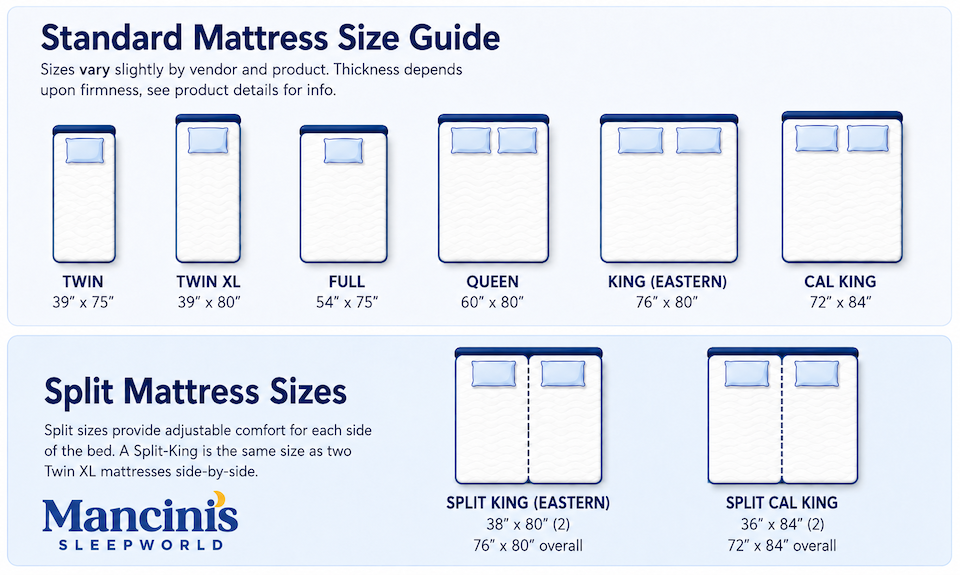
| Size | Width | Length | Best for |
|---|---|---|---|
| Twin | 38" | 75" | Kids, solo sleepers, small rooms, bunk beds |
| Twin XL | 38" | 80" | Taller solo sleepers, teens, dorm rooms |
| Full (Double) | 54" | 75" | One adult with room to stretch; snug for two |
| Queen | 60" | 80" | The most popular size; couples in an average room |
| King | 76" | 80" | Couples who want space, plus kids or pets |
| California King | 72" | 84" | Tall sleepers who want length over width |
| Split King | 38" each (76" together) | 80" | Couples who want one bed with two independent sides |
These are the standard U.S. dimensions in inches. Real mattresses can run about half an inch either way, so treat the chart as nominal rather than exact-to-the-millimeter. A Split King isn't a separate size so much as a configuration: two Twin XL mattresses set side by side, which together cover the same footprint as a King.
The short version, if you only want the answer:
- Solo sleeper, small room:
Twin (or Twin XL if you're tall).
- One adult who wants room to move:
Full.
- A couple who sleep close, average bedroom:
Queen.
- A couple who want genuine elbow room, or who share with kids and pets:
King.
- Tall, and length matters more than width:
California King.
- A couple who can never agree on firmness, or want an adjustable base:
Split King.
How to Find Your Size
A mattress has to satisfy three things at once: the room it goes in, the body that sleeps on it, and everyone else who ends up there. Nearly every sizing regret traces back to optimizing one of those and ignoring the other two. People buy the biggest bed that excites them and then can't open a dresser drawer; or they buy the size they've always had and spend years negotiating 30 inches of width with another adult.
Take the three in order. Most of the time the size sorts itself out by the end.
Start With Who's Sleeping in It
The people in the bed set the floor for how much bed you need, so begin there.
One adult is comfortable on a Full or a Queen, and fine on a Twin or Twin XL if money or floor space is tight. Add a second adult and the math shifts more than people expect. A Queen gives each sleeper about 30 inches of width, roughly the width of a crib mattress. A King divides into about 38 inches each, which is a full Twin's worth of room per person.
Couples who sleep curled toward each other do fine on a Queen. If one of you sprawls, or a child or a dog regularly joins, the King is the size that ends the nightly border dispute.
What this means for you: if you share a bed and either of you tends to wake up hugging the edge, you've outgrown the Queen. A King gives each person about a Twin's width to themselves.
Two more things worth planning for now:
- Length.
Aim for a mattress at least 6 inches longer than the tallest person who'll sleep on it. Twin and Full sizes run 75 inches (6'3"); Twin XL, Queen, and King run 80 inches (6'8"); California King is the longest at 84 inches (7'0"). If anyone in the bed is taller than about 6'2", skip the 75-inch sizes.
- Kids and pets.
If little ones or a dog migrate in during the night, size up. A King absorbs an extra body or two without anyone surrendering sleep.
Then Check Whether It Fits the Room
A bed you love isn't a good buy if you have to sidestep it to reach the closet. Before you settle on a size, measure the room and leave yourself space to actually live in it.
Plan on 2 to 3 feet of clearance along any side you walk past, dress beside, or open drawers next to. A wall side needs none, so a bed tucked into a corner only needs clearance on one or two sides. Then account for the things the chart never mentions: nightstands, the swing of the bedroom door, and any closet or dresser that opens into the floor space.
What this means for you: in a 10-by-10 bedroom, a 76-inch King plus two nightstands fills most of one wall and leaves a narrow walkway. A Queen usually breathes easier in that room. Around 12 feet wide or more, a King fits comfortably.
The cheapest way to be sure before you spend anything: mark the footprint on the floor with painter's tape. Lay out the exact width and length from the chart, then live with it for an evening. Walk the path you'd take to the closet, mime making the bed, open the drawers. You'll know inside an hour whether the size works in that room.
Last, Factor in Your Own Build
Beyond who shares the bed, your own dimensions tip the choice between two sizes that are otherwise close.
- Tall sleepers
should prioritize length. The standard 80-inch Queen and King fit most adults, but past about 6'2" a California King (84") is the one size built to give your feet room without a cramped finish. The trade-off: it's 4 inches narrower than a King.
- Broader sleepers, or couples who'd rather have width than length,
should lean toward the King (76" wide), the widest standard size.
- King versus California King
is where people stall. A King is wider; a California King is longer. Neither is plainly "bigger," so pick the dimension you actually need. If you want to weigh the two in detail, our King vs. California King comparison breaks it down.
Should Couples Size Up?
If you share a bed, this is the decision worth slowing down for, because it's the one most people get wrong, usually by defaulting to whatever size they happened to own last.
| If you... | Look at | Why |
|---|---|---|
| Sleep close, average room | Queen | The popular default; plenty for two who don't mind being near |
| Want real personal space, or share with kids/pets | King | About a Twin's width each; the couples' upgrade |
| Are both tall | California King | The added length two tall partners need |
| Can't agree on firmness, or want an adjustable base | Split King | Two independent sides under one set of sheets |
The Split King is worth a longer look, because most charts barely mention it. It's two Twin XL mattresses placed side by side beneath shared bedding, so together they match a King's footprint. But each half is its own mattress. One partner can sleep on a firmer feel and the other on something plush, and on an adjustable base each side raises and lowers on its own.
For couples who've never once agreed on a mattress, the Split King is often the answer that ends the debate. You can browse the range on our mattress size hub, or skip straight to a tailored recommendation with SleepMatch.
Buying a Size Ahead
A mattress is a 7-to-10-year purchase, so it pays to choose for where you'll be in a few years, not only where you are tonight.
- Buying for a child?
A Twin carries a young kid through early childhood, but a Full or Twin XL will see a child into the teen years without a second purchase. If you'd rather buy once, size up now.
- Expecting the family to grow?
Couples who plan on kids often jump to a King early, knowing that small children and the occasional sick night mean more bodies in the bed.
- Budget for the whole bed, not just the mattress.
A new size usually means a new frame, foundation, and sheets too, so set your budget for the bed and the base. New mattresses priced $499 and up qualify for free local delivery from our 50+ Mancini's Sleepworld locations across Northern California.
Get to Your Size Without the Guesswork
Once you know your room, your body, and who's sharing the bed, the size usually becomes obvious. If you're still between two, you don't have to commit blind.
Take the SleepMatch quiz for a personalized recommendation in a few minutes, online or in store. Or stop by any of our 50+ Mancini's Sleepworld locations across Northern California and lie down on each size to feel the difference yourself. Trying a Queen and a King back to back, in person, tells you more than any chart can. When you're ready to shop by size, start at the mattress size hub.
Frequently Asked Questions
FAQs
The Queen size mattress (60" × 80") is the most popular size in the U.S. It comfortably fits two close sleepers and works in most average-sized bedrooms, which makes it the default for couples and for single adults who want room to spread out.
A Queen suits couples who sleep close in a standard room. A King is the upgrade for couples who want personal space, share with kids or pets, or simply sleep better with more room, since it gives each person about a Twin's width.
A Split King mattress adds independent firmness for partners who can't agree on feel.
A traditional "eastern" king size mattress is 76 inches wide. Leave 2 to 3 feet of clearance on each side you need to walk past, plus space for nightstands and the door swing.
A
King fits comfortably in a room about 12 feet wide or larger; in a 10-by-10 room it will feel tight. Tape the footprint to the floor before you buy to be certain.
A Split King is two Twin XL mattresses (38" × 80" each) set side by side, which together equal a King's footprint (76" × 80"). Because each half is a separate mattress, partners can choose different firmness levels, and on an adjustable base each side moves independently.
Length matters most for tall sleepers. Queen, King, and Twin XL run 80 inches (6'8"), which fits most people.
Past about 6'2", a California King mattress (84") gives the extra length - and typically the go-to choice for very tall individuals.
As a rule, choose a mattress at least 6 inches longer than the tallest sleeper.
A King is wider (76" × 80"); a California King is longer but narrower (72" × 84"). A King suits couples who want width; a California King suits tall sleepers who want length. Our King vs. California King guide covers the full comparison.