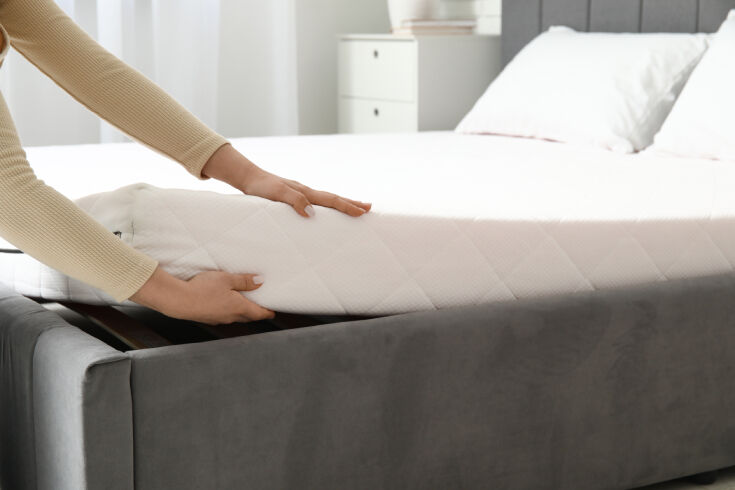

Phase-change materials and cooling fabrics do work, briefly and within limits. Phase-change material soaks up heat until it has absorbed what it can, and cool-to-the-touch fabric feels cool until it has warmed to you. Over a whole night, the room, your bedding, how the mattress is built and your own body decide more than either feature.
| At a glance | Phase-change material (PCM) | Cool-to-the-touch fabric |
|---|---|---|
| What it does | Stores your heat as it melts. It does not make cold. | Pulls heat from your skin on contact, which you feel as cool. |
| When you might notice it | Early, in the first stretch in bed, though in one test people could not feel it | The moment you lie down and touch the fabric |
| What ends it | It has absorbed what it can, and a warm room gives it less chance to recharge | The fabric warms toward your skin |
| What carries on after | The rest of the build, the bedding and the room | Air and moisture moving through the fabric, plus the build, the bedding and the room |
How Does Phase-Change Material Work?
Phase-change material melts at a set switching temperature. As it melts, it soaks up heat and stores it. As it cools and turns solid again, it gives that heat back. In fabrics and foams it is sealed in tiny capsules, so the melted material stays contained. It stores heat. It does not make cold.
How much heat it takes up, and for how long, depends on several things:
- how much PCM there is, and its switching temperature
- the gap between your skin temperature and the PCM's
- how much of your body touches it, and what layers sit in between
- whether it started fully solid
So it works for a while, then it has absorbed what it can.
To work again, it has to recharge by cooling below its switching point. A bedroom that stays warm gives it less chance to do that. That makes PCM a buffer for your first stretch in bed, not a cooler for the whole night.
What Has Research Actually Measured?
Researchers have tested PCM and cooling bedding directly. The results line up with the physics.
| Study | What was tested | What it found |
|---|---|---|
| Lab test of a PCM T-shirt | A heated manikin wearing the shirt in a hot, humid chamber. A garment test, not a mattress. | The PCM absorbed heat early in the test. After that, the PCM layer acted as one more layer of insulation. |
| A lie-down test on two mattresses | Twenty young, active adults lay for twenty minutes on a PCM mattress and on a conventional one. | On the PCM mattress, their backs warmed less and the sheet warmed more, because the heat went into the bed. They rated their comfort and how warm they felt no differently. |
| A review of cooling-bedding studies | Nine studies of cooling mattresses, toppers and pillows in healthy adults. This covered cooling bedding in general, not PCM alone. | No measurable difference in time to fall asleep, sleep efficiency, sleep stages, time awake or total sleep. Some studies saw body temperature drop in the short term. The certainty of the evidence was low to very low. |
PCM does what its physics says and gives a short buffer, but in these tests the difference was too small to feel or to change measured sleep.
Why Cool-to-the-Touch Fabric Stops Feeling Cool
"Cool to the touch" is a contact effect. When your skin meets fabric cooler than itself, heat moves quickly from skin to fabric, and your skin surface cools for an instant. Textile labs test it as an instant contact property. Because it depends on the fabric being cooler than you, the feeling evens out once the fabric has warmed toward your skin. Researchers also test cooling fabrics on three properties that keep working after that first touch:
Air passing through
how easily air moves through the fabric.
Moisture passing through
how easily water vapor escapes from your skin.
Sweat taken up and moved
how well the fabric absorbs sweat and carries it away.
What Else Makes You Sleep Hot?
If you wake up hot, the cover is often only a small part of the story. Start with what is easiest to change.
| What adds heat | What research shows | What to try first |
|---|---|---|
| A warm room | With normal bedding and sleepwear, a hot room leads to more time awake. | Keep the bedroom quiet, cool and dark before you change anything else. |
| Humidity | Humid heat adds to the load, because sweat cannot evaporate and skin stays wet. | Notice whether your hot nights are also sticky ones, and treat the room's air as part of the problem. |
| The bedding stack | The temperature and humidity between you and your covers, the "bed climate", play a crucial role. Every layer between your skin and a PCM surface changes how much heat it can take up. | Count your covers, mattress protectors and any mattress toppers as part of the bed. Try lighter covers first. |
| The mattress build | In one lab test with a heated, sweating manikin, a latex-foam mattress set ran warmer and more humid next to the body than an innerspring set. It was one test, not a rule, and it did not test memory foam. | Compare builds, not just covers. Lie on hybrid mattresses and innerspring mattresses as well as foam ones. |
| A partner | Two people add body heat to a shared bed and may not agree on warmth. | Use separate covers on each side so each of you can adjust without changing the mattress. |
| Heavy or unexplained night sweating | Contact a health care provider if you often sweat during sleep, sweat a lot, or cannot explain the sweating. | That is a question for your doctor. |
How to Test Cooling in a Showroom
At a Mancini's Sleepworld location, one of 50+ locations across Northern California, you can lie on hybrid, innerspring and memory foam mattresses with different cooling approaches, from many brands side by side, and run this lie-still test.
- Start with support. Lie on a few firmness levels first and settle the one that holds you well. Then compare cooling only between mattresses at that level, so support decides first.
- Pick two of a similar feel with different builds. Browse the mattresses in the cooling category as a place to compare. Some mattresses there list phase-change material or cool-to-the-touch cover fabric among their construction features.
- Lie down in your real sleep position. Stay still for several minutes. A hand press on the cover only tells you about the first touch.
- Notice when the first cool feeling fades. Then judge how the bed feels once it has warmed to you, because that is the feel you sleep on.
- Picture your own bedding on top. Keep in mind the protector, topper and covers you will use at home, since each one is another layer.
- Test together if you share the bed. Lie down side by side. Keep in mind that a store is not your bedroom: the room and a full night change things.
Is a Cooling Feature Worth Paying For?
A cooling feature is worth what it does for you once the bed has warmed up. Its value depends on where the cooling material sits and how much of the build is about airflow. It also depends on how the bed feels once warm and what you will put over it. A cooling cover sits closest to you. Material deeper in the build has more layers between it and your skin.
Judge it with the lie-still test. If you cannot tell two similar mattresses apart once they have warmed to you, do not let a cooling label decide. On durability, how a cooling cover holds up to washing and wear depends on how it is made. In fabrics, PCM is sealed in tiny capsules. Follow the care label, and ask whether the cover is removable before you buy.
A Sleep Specialist can answer these questions for each mattress you are comparing:
- Where does the cooling material sit: in the cover, in a top layer, or deeper in the build?
- What is underneath it?
- Does the cover come off to wash?
- What does the care label ask for?
- How does this mattress compare with a similar-feel one without the feature, once both have warmed?
When the Cool Feeling Fades: Questions for Hot Sleepers
It Felt Cool at First and Now It Doesn't: Is Something Wrong?
Not necessarily. Cool-to-the-touch fabric only feels cool while it is cooler than you, and PCM stops soaking up heat once it has absorbed what it can. A warm room gives PCM less chance to recharge, so check the room and your bedding stack before you blame the mattress.
My Partner Sleeps Cold: Can One Bed Suit Us Both?
Often, yes, because the covers can do much of the work. Two people add body heat to a shared bed, and separate covers on each side let each of you adjust without changing the mattress. If you are shopping, run the lie-still test together.
Should I Change My Bedding Before Buying a New Mattress?
It is a sensible first step. The bed climate between you and your covers plays a crucial role, and a hot room leads to more time awake. Keep the bedroom quiet, cool and dark, try lighter sheets, and look at your mattress protectors as part of the stack. If you still wake up hot after that, the build is the next thing to compare, and the lie-still test is how to do it.