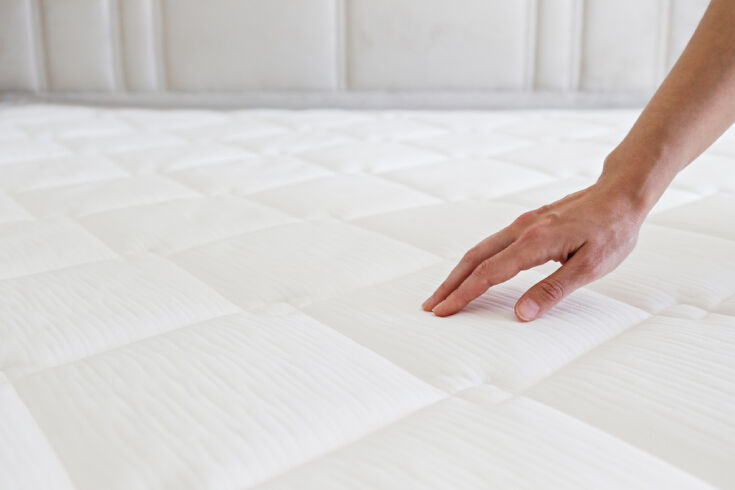

If you searched for a non-toxic mattress, start here: "non-toxic" is a seller's claim, not a standard a mattress meets. The labels worth knowing are separate programs. Each checks one thing on one part: the foam, the fabric, the latex, or what the finished product gives off into indoor air.
Table of Contents
- What a Certification Label Does Not Tell You
- Which Certification Matters Most?
- Is a Certified Mattress Worth Paying More For?
- How to Check a Certification Before You Buy
- Flame Retardants and Fire Barriers: What the Rules Say
- Take This With You: A Certification Checklist
| Label | What it certifies, in the program's words | Which part of a mattress | Who runs it |
|---|---|---|---|
| CertiPUR-US | Flexible polyurethane foam, "not furniture, product lines or companies"; made without formaldehyde, ozone depleters, CPSC-regulated phthalates, mercury, lead and other heavy metals; low VOC emissions | Polyurethane foam layers only | Alliance for Flexible Polyurethane Foam, a nonprofit |
| GREENGUARD Gold | Low chemical emissions into indoor air; Gold is the tier "for sensitive groups" | The finished product | UL Solutions |
| eco-INSTITUT-Label | A certification "for your indoor air quality"; labeled products described as "low-pollutant and low-emission" | The finished mattress, topper or pillow | eco-INSTITUT Germany |
| OEKO-TEX STANDARD 100 | "A label for textiles tested for harmful substances," covering every thread, button and accessory | The certified textile item, such as a cover fabric | OEKO-TEX, through accredited certification bodies |
| GOTS | "Textiles made with organic fibres," with environmental and social criteria | Fiber and fabric parts, such as organic cotton or wool | Global Standards, a non-profit |
| GOLS | Products made from organically grown natural rubber latex | The latex | Originally developed by Control Union |
What a Certification Label Does Not Tell You
A logo answers one question about one part. Here is what it leaves open.
A foam label is not a mattress label
CertiPUR-US covers polyurethane foam only. Latex foam is outside its scope, and a mattress with a latex layer can still show the logo if its polyurethane foam is certified. Hybrid mattresses combine coils with foam and fabric layers, so you may see several labels, each on a different part.
A company listing is not a model's certification
The CertiPUR-US program lists companies in its directory, not models. Some companies use certified foam only in certain products, so the program suggests asking the manufacturer. Companies do not have to put the logo on the product.
Emission results come from a lab
CertiPUR-US measures foam emissions in a small test chamber after 72 hours, with a limit under 0.5 parts per million. GREENGUARD Gold products must meet the California Department of Public Health's emissions test method. Both are lab conditions, not your bedroom.
Low emissions are not zero
VOCs are gases given off by many products, including furnishings, and there are no federally enforceable standards for VOCs in homes. CertiPUR-US tests for low emissions, not zero. For a new-mattress smell, EPA's advice includes increasing ventilation when using products that give off VOCs, and the maker's instructions cover the rest. If you notice symptoms, that is a question for your doctor.
None of these is a government rule
CertiPUR-US was developed by the foam industry with input from environmentalists, chemists and others, and a nonprofit administers it. The CPSC's role with mattresses is the federal flammability rules.
None rates comfort, support or how long a mattress lasts
A label speaks to materials. How a mattress feels and holds you is a separate question.
"Non-toxic" on a listing is the seller's claim
The FTC's Green Guides say that claim likely tells buyers a product is non-toxic for both people and the environment. Sellers need competent and reliable scientific evidence, or must clearly qualify it.
Which Certification Matters Most?
The one that checks what you care about, on the part you care about. Start with your concern and work across.
| If what matters most is | Labels that speak to it | What to confirm |
|---|---|---|
| What is in the foam | CertiPUR-US, for polyurethane foam such as the layers in memory foam mattresses | That this model's foam is certified, not just that the company is listed |
| What the finished mattress gives off into indoor air, such as for a child's room or a sensitive sleeper | GREENGUARD Gold; eco-INSTITUT-Label | That the certification names this finished product, not one supplier's material |
| Fabric against skin | OEKO-TEX STANDARD 100; Class 1 is for babies and children up to 3 | Which textile item carries the label, and its label number |
| Organic fibers or latex | GOTS for cotton or wool; GOLS for latex | The GOTS grade and certification number; whether GOLS covers the final product |
| Added flame retardants | No single label settles it; CertiPUR-US screens its foam for certain flame retardants | What the fire barrier is made of (see the flame retardants section below) |
A label narrows the materials, but it says nothing about support or how a mattress feels, so lie on every mattress on your shortlist before a logo decides for you.
Is a Certified Mattress Worth Paying More For?
A label is worth weighing when you know what backs it:
CertiPUR-US
foam tested by independent accredited labs twice in the first year, then annually, plus random checks.
GREENGUARD
a manufacturing review and routine testing.
OEKO-TEX
a certificate that lasts one year after lab tests and an on-site visit.
GOTS and GOLS
the supply chain is traced. GOTS requires every company in the chain to be certified, with annual on-site audits; GOLS uses transaction certificates from plantation to retailer.
Certification is worth paying for when it checks the thing you care about, on the part you care about, and you can verify it yourself.
On lasting longer: only CertiPUR-US lists durability criteria, and those apply to the foam. None of these labels is a lifespan rating. Wear comes from how a mattress is built, so ask about the layers, their materials and how they are put together.
How to Check a Certification Before You Buy
Six steps turn a logo into something you can confirm.
- Start with the listing. Some mattress listings at Mancini's Sleepworld name the certifications their materials carry in the construction details, such as foams listed as CertiPUR-US certified. Browse the full mattress lineup and note which material each label is attached to.
- Ask which part is certified, and for which model. "Certified foam" and "certified mattress" are different answers.
- Look it up with the program. Search the CertiPUR-US directory for the company, OEKO-TEX's Label Check for a label number, and UL's SPOT database for GREENGUARD products. For organic claims, use the GOTS certified-suppliers list or Control Union's list of certified GOLS clients. eco-INSTITUT's database searches by certification number, product or manufacturer.
- Read the law label. In California, the law label on bedding must list the kinds, types and percentages by weight of the filling materials, in generic terms, largest first.
- Compare side by side. At a Mancini's Sleepworld location, one of 50+ locations across Northern California, mattresses from many brands sit on one floor. Ask a Sleep Specialist to show you the law label and certification details for each mattress on your shortlist, and which part each label covers.
- Keep a record. Save the model name, any label or certification numbers, and a photo of the law label.
Flame Retardants and Fire Barriers: What the Rules Say
New mattresses sold in the US must meet two federal flammability standards from the CPSC: one for cigarette ignition (16 CFR 1632) and one for open flame (16 CFR 1633). Crib mattresses have further federal requirements. CPSC staff guidance says the open-flame rule does not specify flame-retardant chemicals: makers may meet it with inherently flame-resistant materials and fire barriers, as well as flame-retardant chemicals. In California, since January 1, 2020, the law has barred selling new mattresses containing listed flame-retardant chemicals above 1,000 parts per million, with exemptions for some components that the law spells out.
Some makers wrap the foam core in barrier fabrics made with fiberglass to meet flammability standards. The CertiPUR-US program advises never removing a mattress cover, even one with a zipper, unless it is meant to come off for washing, and checking with the manufacturer first. A mattress protector keeps the mattress clean instead.
Take This With You: A Certification Checklist
Questions to put to the listing, the law label or a Sleep Specialist for each mattress you try.
- Which part does each logo cover? Foam, cover fabric, latex or the finished mattress.
- Is this model certified, or is the company only listed? Ask for the model, and for a label or certification number you can check with the program.
- Which "organic" is it? A GOTS "organic" grade means at least 95% certified organic fibers; "made with organic" means 70% up to 95% and must state the exact percentage. GOTS covers fiber and fabric parts, not foam, coils or latex; GOLS covers latex.
- For a child's room, which tier? UL describes GREENGUARD Gold as its tier "for sensitive groups," for places like nurseries and schools; OEKO-TEX STANDARD 100 Class 1 has its strictest limits. A pediatrician is the right person for safe-sleep questions.
- What is the fire barrier made of?
- What does the law label list? The filling materials by kind and percentage by weight, largest first. Take a photo of it.