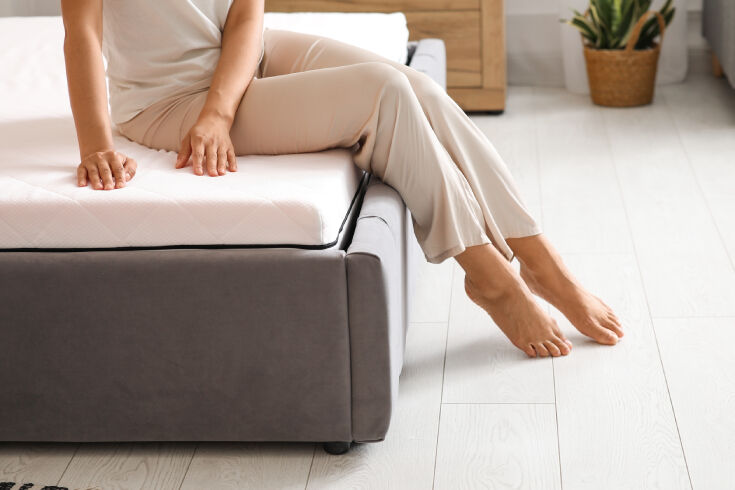

The most durable mattress within any type is the one whose softer comfort layers and support core are well made for the weight they carry, set on the base its maker calls for, and cared for as the maker says. Those are things you can ask about and test, whatever the type. What no one can promise is a type-wide winner: a type name tells you how a mattress is built, not how well, and materials vary widely within each type.
Table of Contents
- Why Mattresses Sag
- Body Impression or Sag? How to Tell
- What Your Foundation Has to Do
- How to Judge Durability Before You Buy
- Care Habits That Slow Sagging
- How Long Will It Last, and Is Paying More Worth It?
- Toppers, Warranty Claims and Heavier Sleepers
| Type | What holds you up | Where wear often shows first | What to check |
|---|---|---|---|
| Hybrid mattresses | Coils, often pocketed, under foam or latex layers | The comfort layers, and the edge if it is not reinforced | What the comfort layers are made of; sit on the edge to feel how it holds |
| Innerspring mattresses | A connected coil unit under padding | The padding compresses, and springs under the heaviest area can weaken | Whether it is two-sided and can be flipped; how the middle feels |
| Latex (often met as a layer inside hybrids) | Springy latex that recovers quickly | Impressions can still form in the latex or in the layers around it | What the surrounding layers are made of, not only the latex |
| Memory foam mattresses and all-foam | A firmer foam core under softer foam | The softer foam takes impressions, and edges compress when sat on | What the softer layers sit on; sit on the edge where you really sit |
Why Mattresses Sag
In many builds, the softer comfort layers on top wear first, before the support core. Wear also gathers where your weight rests. Researchers who tested springs from used coil-spring mattresses found that springs from the middle compressed more easily than springs from the head and foot, and that the weakening may not show when nobody is on the bed.
Firmness and durability are separate things. Firmness is how the surface feels; foam density is how much material is packed in. How long foam keeps its firmness depends on its density, the load it carries and how long it carries it. In a lab test that compressed foam samples over and over, denser samples of regular foam lost less firmness, while for the softer foams tested, extra density made little difference. Density is one clue, not a guarantee.
Can Durability Be Measured?
Yes, in a lab. Standard ASTM test methods measure a mattress's firmness retention, durability and height change so mattresses can be compared. The methods set no pass or fail line, so a result is something to compare, not a verdict.
Body Impression or Sag? How to Tell
A body impression is a shallow shaping of the comfort layers where you sleep as the materials settle, and some is normal. A sag is a deeper dip where the support underneath has given way; it stays with nobody on the bed and tips you toward it.
- Strip the bed. Take everything off down to the bare mattress so bedding cannot hide a dip or create one.
- Look with nobody on it. Lay a straight edge, such as a broom handle, across the surface where you sleep and look for a gap underneath.
- Lie in your usual spot, then in an untouched one. If your spot tips you or feels softer, the support there may be weakening, even if it looked flat when empty.
- Check the base. Take the mattress off and look at the box spring, slats, center support and frame. A base problem gets fixed before anything is replaced.
- If you think it is a defect, contact the seller first. Have your warranty and your receipt ready, since the receipt proves the purchase date and that you are the original owner.
If a dip comes with aches or pain, that is a question for your doctor.
What Your Foundation Has to Do
A mattress is only as flat as what is under it. A tired base can let a mattress dip, or make a sound one look sagged.
| What to check | What a problem looks like | What to do |
|---|---|---|
| Box spring | Its own surface sags or dips with the mattress off | Replace the base before judging the mattress |
| Slats | Broken or bowed slats, or slats spaced too far apart for that mattress | Replace damaged slats; check the maker's spacing requirement |
| Center support | No support down the middle of a larger bed | Add the center support the base or mattress maker calls for |
| Frame | A bent or bowed rail that lets one side drop | Repair or replace the frame |
| Adjustable base | A mattress its maker does not list as suitable for adjustable bases | Check the mattress maker's guidance before pairing them |
Base requirements are set model by model, so ask a Sleep Specialist which base the maker of your mattress calls for; Mancini's Sleepworld's range of foundations and bases includes standard and low-profile foundations and adjustable bases, some from the mattress makers themselves.
How to Judge Durability Before You Buy
Durability cannot be felt in a few minutes. Lying down tests the feel on day one; asking what is inside judges how it will wear. At a Mancini's Sleepworld location, one of 50+ locations across Northern California, you can compare many brands and builds side by side.
- Settle the feel first. If you want a starting point, ask for the SleepMatch body scan at a SleepMatch location, which gives you a color-coded support report. Whatever your color, durability is judged by what sits under the feel, so there is no need to go firmer than you want in the hope it lasts.
- Lie down like you sleep. Use your real sleep position, first in your usual spot and then in the middle.
- Sit on the edge. Sit where you would sit to dress or stand, and notice whether the edge holds you or folds.
- Compare two builds of similar feel. Pick two options that feel alike but are built differently, from different brands and price points, from across the full mattress lineup, and try them side by side.
- Ask what is inside. A Sleep Specialist can tell you what the comfort layers and support core of each are made of. For foam layers, look for the CertiPUR-US seal: the foam meets that program's standards for content, emissions and durability, analyzed by independent, accredited labs. It covers the foam only, not the whole mattress.
- Ask to read the warranty. Read it before you buy, not after a problem appears.
Care Habits That Slow Sagging
Rotate or flip as the maker says
Many one-sided mattresses are turned head to foot rather than flipped, and two-sided ones can be flipped. Rotating moves the spot your weight rests on.
Use a protector
It keeps spills and stains off the mattress; see mattress protectors.
Spread out your edge sitting
Sitting on the same stretch of edge every day concentrates wear there.
Don't stand or jump on the bed
Either one strains the mattress.
Keep checking the base
Look at slats, center support and frame now and then, since a failing base shows up in the mattress.
How Long Will It Last, and Is Paying More Worth It?
| The question | The straight answer | How to judge it |
|---|---|---|
| How long will it last? | There is no reliable figure by type. It depends on the build, the weight on it and how it is used, the base and the care. | Watch the mattress, not the calendar: a dip that stays when the bed is empty, rolling toward the middle or a partner, an edge that collapses when you sit, springs you can feel or hear, sleeping better on other beds. |
| Is a pricier mattress more durable? | Not guaranteed. Price reflects materials, construction, brand and features such as a cooling cover, zoning or extra height, not durability alone. | Judge the build: what the comfort layers and support core are, how the edge holds up, and what the warranty says. |
| Does a firmer mattress sag less? | Not necessarily. Firmness is how the surface feels, and a firmer foam is not necessarily more durable. | Choose firmness for comfort, then ask what the layers are made of. Density is one clue, not a guarantee. |
| Does a longer warranty mean a longer life? | No. A warranty's length is how long defects are covered, not a forecast of how long the feel will last. Each maker's warranty sets its own measure of when a dip counts as a defect. | US law says any warranty must be available to read before you buy, in a store or online. Ask what it covers, what the company will do if the product fails, and whether coverage depends on using and maintaining it as directed. |
Toppers, Warranty Claims and Heavier Sleepers
Can a topper fix a sagging mattress?
No. A topper changes how the surface feels; it cannot restore support that has given way underneath. If the support is sound and you only want a different surface feel, mattress toppers can do that job.
Is a sagging mattress covered by the warranty?
Mattress warranties come from the manufacturer, cover defects rather than normal wear or comfort preference, and vary by brand and model. Mancini's Sleepworld helps customers through the claim process. The details for your mattress sit with its maker; the warranty page is the place to start.
What should heavier sleepers and couples look for?
Wear gathers where weight rests, and weakening under the middle may not show on an empty bed, so test the middle as well as each side. Lie down together in your real positions and sit on the edge where each of you sits. Going firmer will not by itself buy more life, since firmness and durability are separate; ask what the comfort layers and support core are made of instead.