Latex vs. Memory Foam Mattresses: Which Should You Choose?
Published: July 30th, 2026

How to Choose: Latex vs. Memory Foam Mattresses
Latex and memory foam are two of the most different feels you can buy, and once you understand what actually separates them, the choice gets a lot clearer.
Table of Contents
- Start Here: They Feel Completely Different
- Latex vs. Memory Foam at a Glance
- The Trade-Offs Buyers Get Surprised By
- Choose Latex If… / Choose Memory Foam If…
- One Caveat: You Are Buying a Mattress, Not a Material
- The Easiest Way to Decide: Try Both
- Frequently Asked Questions
Here is the short version, so you can skip ahead to whichever half fits you:
- Choose latex if
you sleep hot, change positions or get out of bed during the night, want the longest-lasting option, or prefer natural materials, and you are comfortable paying more upfront.
- Choose memory foam if
you want a deep, cradling hug and strong pressure relief, share a bed with a restless partner, sleep fairly still, and want to spend less at checkout.
The rest of this guide shows you why, walks through the trade-offs buyers are most often surprised by, and helps you match one to your own situation.
Start Here: They Feel Completely Different
The word "foam" hides a big difference in feel.
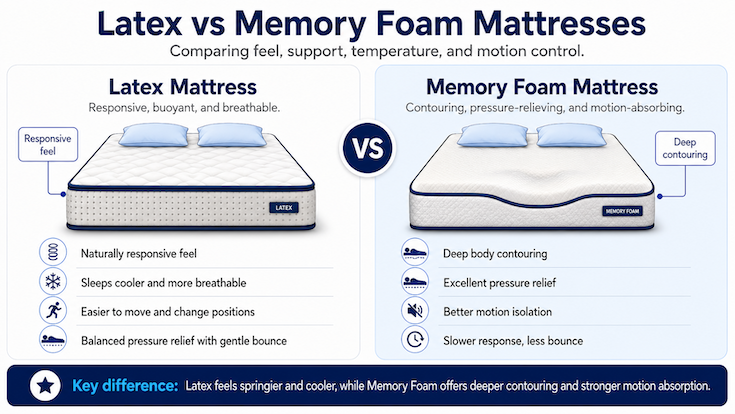
Memory foam (also called viscoelastic foam) softens with your body heat and molds slowly around you. You sink in, and it holds that shape for a moment after you move. People describe it as a hug, a cradle, or being gently wrapped. That slow, close contour is exactly why it relieves pressure so well.
Latex does the opposite. It is springy and responsive: press it and it pushes right back. Instead of sinking in, you rest more on top, with a gentle buoyant support. People describe it as bouncy, lively, or "floating."
Neither feel is better. They suit different bodies and different priorities, which is what the rest of this comparison is about.
Latex vs. Memory Foam at a Glance
These are typical tendencies across the two materials, not guarantees for every model. Construction, firmness, and quality all shift the details.
| What Matters | Latex | Memory Foam |
|---|---|---|
| Feel | Buoyant, rests on top, gentle support | Deep contouring hug, molds and holds |
| Responsiveness | Springs back instantly, easy to move on | Slow to recover, you settle into it |
| Temperature | Sleeps cooler; open, breathable structure | Traps more heat unless built with cooling features |
| Pressure relief | Good, more even than deep | Excellent, cradles hips and shoulders |
| Motion isolation | Some bounce, transfers more movement | Excellent, absorbs a partner's movement |
| Durability / lifespan | Long; natural latex often 12 to 20+ years | Shorter; commonly around 7 to 10 years |
| Upfront price | Higher | Lower |
| Materials | A natural / organic option is available | Typically synthetic (petroleum-based) foam |
If a table is all you needed, you already have your shortlist. (Still weighing a coil-based bed too? That is a different fork; see our memory foam vs. hybrid comparison for that one.) If you want to make a confident call, the next section covers the parts most comparison pages leave out.
The Trade-Offs Buyers Get Surprised By
A feature list tells you what each material does. These three trade-offs are what actually decide which one you will be happier on.
The "Feeling Stuck" Question
This is the one most buyers underestimate. Memory foam's slow recovery is the same property that makes it hug you: when you shift, it takes a moment to let go and reshape. For a still sleeper, that is unnoticeable. For anyone who moves, it can feel like climbing out of a shallow dip every time you turn.
Latex is the opposite. Because it springs back instantly, changing positions, rolling over, or sitting up and getting out of bed all take less effort.
That difference stops being a preference and becomes practical if you are a combination sleeper who switches positions all night, a couple where one person is always repositioning, someone who gets up during the night, or you are shopping for anyone who wants to turn and get out of bed with less effort.
So if easy movement is on your list, weigh responsiveness as heavily as comfort, and lean toward latex. If you want to be held in one cozy position, that same "stuck" feeling is the memory foam hug you are looking for.
Paying More Upfront, Less Per Year
Latex almost always costs more at checkout. That sticker gap is real, and it is the main reason people talk themselves out of it. But the upfront price is only half the math.
Because natural latex commonly lasts 12 to 20+ years and memory foam commonly lasts around 7 to 10, the cost spread narrows once you divide by the years you actually sleep on it. A pricier latex bed that lasts roughly twice as long can end up costing less per year than a cheaper memory foam bed you replace sooner.
The takeaway: if you plan to keep one mattress for the long haul, price it per year, not just per receipt. Two honest caveats keep this fair. First, these are typical ranges, not promises; care, body weight, and build quality all matter. Second, lasting a long time is not the same as staying comfortable a long time, so a longer lifespan only pays off if you still love the feel years from now.
What "Natural" and "Organic" Actually Mean
Latex is the material with a genuine natural option, and for many shoppers that is the whole appeal. It is worth knowing what the labels mean before you pay for them.
"Natural latex" comes from rubber tree sap. "Blended" or "synthetic" latex mixes in or fully uses petroleum-based material, and it often does not match the durability that makes natural latex worth the premium. "Organic" is a step further: it points to certified organic components, not just an earthy name. Memory foam, by contrast, is a synthetic foam, and some models have a mild initial smell (off-gassing) that fades over the first few days.
If the natural angle is why you are considering latex, check whether a mattress is natural, blended, or certified organic before you decide, because the word alone does not tell you. And one practical note: if anyone in the bed has a known latex allergy, ask the manufacturer about the specific mattress before you buy, since natural and synthetic latex are not the same on that front. For a full breakdown of certifications and materials, our guide to organic vs. non-organic mattresses goes deeper than this comparison needs to.
Choose Latex If… / Choose Memory Foam If…
Here is the decisive part. Find the description that sounds most like you.
Lean latex if you:
- Sleep hot and want a cooler-sleeping surface
- Move a lot, share the bed, or need to get in and out easily
- Want the longest-lasting mattress and will keep it for many years
- Prefer natural or organic materials
- Like a supportive, buoyant feel rather than a deep sink
- Are shopping for someone who needs to reposition and get out of bed without a fight
Lean memory foam if you:
- Want a deep, cradling hug and close-contouring pressure relief
- Have a partner whose movement wakes you (motion isolation is its strength)
- Sleep mostly in one position and stay put through the night
- Are more comfortable with a lower upfront price
- Like the feeling of being wrapped and held rather than resting on top
Most people see themselves clearly in one of these lists. If you land in both, that usually means the two things you want most (say, a cool surface and a deep hug) live in different materials. That is exactly the case where lying on both is worth the trip.
One Caveat: You Are Buying a Mattress, Not a Material
Everything above describes how latex and memory foam tend to behave. But you never actually buy "latex" or "memory foam" on their own. You buy a specific mattress, and its firmness, thickness, cover, and support layers can shift the feel a long way from the material stereotype. A firm memory foam and a plush latex can feel closer than the labels suggest.
That is why the most reliable way to choose is not to settle the debate on paper, but to lie on both, in your normal sleep position, long enough to actually settle in. Roll over. Sit on the edge and stand up. If you share a bed, have your partner move while you lie still. Those few minutes tell you more about feel than any spec sheet, and the comfort guarantee window covers what a showroom visit cannot.
The Easiest Way to Decide: Try Both
You do not have to make this call from a chart. At Mancini's Sleepworld, you can lie on latex and memory foam side by side, with a mattress expert to point you toward the right firmness for how you actually sleep.
Two things make that simple:
- SleepMatch
is our matching diagnostic. In store, its sensors map your pressure points and body contours; online, a quick quiz works from your answers. Either way it sorts mattresses into four support levels, from Gold (plush) and Green (medium) up to Blue (firmer) and Red (firmest), so you are comparing the right options instead of guessing.
- With 50+ mattress store locations across Northern California,
there is usually a showroom nearby where you can try both the same day. Find your nearest location to get started.
When you are ready to browse, explore our memory foam mattress collection, our environmentally friendly and organic mattresses (the closest home for natural latex), or, if a cool surface is your priority, our best mattresses for cooling. Free local mattress delivery is available in Mancini's delivery area, financing is available (subject to credit approval), and eligible mattresses are backed by our Comfort Guarantee, so you have time to be sure.
Frequently Asked Questions
Not necessarily. Both come in a range of firmness levels. The real difference is the type of support: latex feels buoyant and springs back, while memory foam softens and molds around you.
You can find a soft latex and a firm memory foam, so it is the feel, not just the firmness, that sets them apart.
It depends on how much cushioning you want at your pressure points. Side sleepers who want their hips and shoulders deeply cradled often prefer memory foam's contouring, while back sleepers who want even, buoyant support often prefer latex.
Firmness matters as much as material here, which is why trying both in your usual position is the best test.
It can be, depending on your priorities. Latex costs more upfront but typically lasts longer, so measured per year the gap narrows.
It tends to be the better value if you sleep hot, want easy movement, prefer natural materials, and plan to keep one mattress for many years. If you want a deep hug at a lower price, a memory foam mattress may be the better fit.
Generally, yes. Latex has a more open, breathable structure that lets heat move away from your body, while traditional memory foam holds more heat.
Many memory foam mattresses now add cooling features to close that gap, so if temperature is your main concern, ask what a specific model is built with.
Read our guide on the Best Cooling Mattresses for Hot Sleepers.
Memory foam is the stronger choice for motion isolation, meaning it absorbs one partner's movement so the other is less likely to feel it. Latex has more bounce and transfers a bit more motion.
If one of you also needs to move or exit the bed easily at night, weigh that against the motion trade-off, or try both together before deciding.
Natural latex is the most durable, commonly lasting 12 to 20 or more years. Memory foam commonly lasts around 7 to 10 years, and lower-density or blended options can wear sooner.
Quality, care, and your body weight all affect where a specific mattress lands in those ranges.