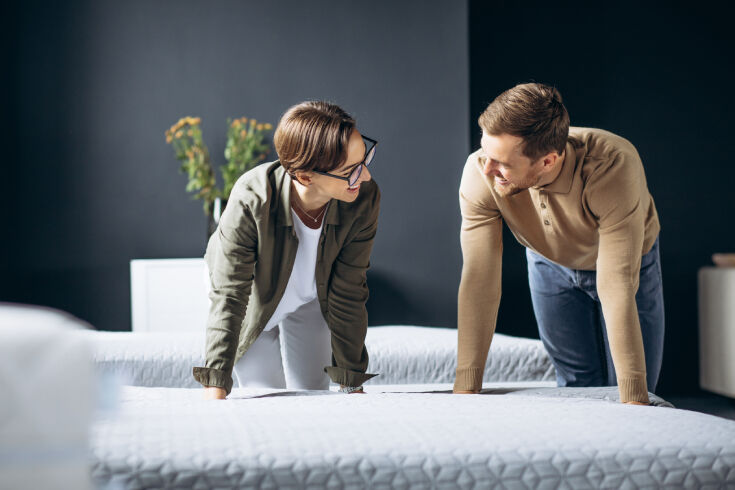

Compare luxury foam and hybrid mattresses in two passes: read the build first, then decide lying down, with one of each side by side. "Luxury" is a label the maker chooses, not a grade set by any standard, and both kinds come in simple and elaborate versions. So the test decides, not the tag.
| Luxury all-foam | Luxury hybrid | |
|---|---|---|
| What is underneath | Foam comfort layers (memory foam, polyfoam, sometimes latex) over a dense foam support core | Foam or latex comfort layers over a coil support unit, often individually wrapped (pocketed) coils |
| First feel | Memory foam softens under warmth and pressure, so it tends to contour closely and hold still | Tends to push back more and feel bouncier; latex in either build adds spring |
| Changing position and getting up | Foam recovers slowly, so rolling over or getting up can take a little more effort | The push-back often makes moving around easier |
| A partner's movement | Foam absorbs movement rather than passing it on | Pocketed coils move independently, so many hybrids also limit it; how much depends on the coil type and the foam on top |
| The edge | Can compress more when you sit near it, though some add a firmer foam border | Many have a reinforced perimeter, so the edge sinks less when you sit or lie near it |
| Heat and airflow | Some sleepers find dense foam feels warmer | The coil unit leaves open space for air to move |
| Bounce and sound | Silent, with little bounce unless latex is in the build | Bouncier, and the coils can make small sounds as they compress |
| Adjustable bases | Many are made to bend with one; the maker's specifications say which | Some are made to bend with one; the maker's specifications say which |
Heat is worth testing rather than assuming: in one lab test with a heated, sweating manikin, a latex foam mattress set ran warmer and more humid next to the body than an innerspring set, and both our memory foam mattresses and hybrid mattresses range from simple to elaborate builds.
What "Luxury" Means in Construction Terms
In construction terms, "luxury" often signals some mix of six things. Each is something you can check with your body.
Richer comfort materials
Latex, thicker foam, more foam layers, or a layer of small micro-coils near the top. Lying down, latex feels springy, while thicker memory foam lets you settle in and contour more.
More layers and zoning
Zoned support uses firmer and softer areas along the length of the bed, for example firmer where the hips sink most. You may notice the middle of the mattress holding you differently from the head and foot ends.
The edge
A reinforced edge sinks less when you sit on it or sleep near it. Sit on the side as if putting on shoes and feel how far it gives.
The cover
Premium covers use knit fabrics, natural fibers such as wool or cotton, or quilting. You notice the cover as the first touch of the surface, not as support.
Handwork
Tufting pulls cords or ties through the mattress to hold the layers in place, leaving a dimpled surface. Some traditional builds are tufted by hand, and some have hand-stitched sides. You can see and feel the dimples on top.
The top and the height
A pillow top is an extra padded layer sewn on top with a visible seam. A euro top is sewn flush with the sides, and a tight top has no separate top layer. Extra layers make a taller mattress, but height alone says little about feel.
None of these is a standard that earns the word "luxury", which is why the test decides.
Is a Luxury Mattress Worth the Extra Cost?
Price follows the materials, the complexity of the layer build, handwork and finishing, and the name, not the category, so a hybrid is not automatically pricier than foam.
| What the extra pays for | Can you feel it? | How to judge it |
|---|---|---|
| Comfort materials, more layers, zoning and the edge | Yes, lying down | Lie on it back to back with a simpler model of the same type and comfort group |
| Cover, quilting and handwork | Partly: you feel the surface, not the build inside | Look closely and ask what is under the cover; it is fair to value these if how a bed is made matters to you |
| The name on the label | Not directly, but it shapes what you expect to feel | In one study, 41 people tried two identical mattresses, one presented as cheap and one as high-level and expensive; 33 rated the "expensive" one more comfortable |
If you feel the difference in what matters most to you, that is what the extra buys; if you cannot tell two mattresses apart lying down, the extra is not buying you comfort.
Nor does the label, or the category, decide how long a mattress lasts. How long it keeps its feel depends on its materials and build: the comfort layers, where body impressions form, and the core. The base under it and how you care for it matter too. In one small lab durability test, a foam-core mattress compressed a little at first and then held steady, and a pocket-spring mattress softened slightly. Both kept their overall firmness, and the authors call the results preliminary. Ask what the comfort layers are made of and which foundations suit the mattress.
Why Comfort Names Don't Line Up Across Brands
Comfort names belong to each maker. The mattress listings at Mancini's Sleepworld show names taken straight from each maker's own product names, such as "Luxury Firm", "Cushion Firm" or "Plush Euro-Top". One brand's "Luxury Firm" follows that brand's own naming, not a shared rule, so it can feel quite different from another's. Top names like pillow top or euro top describe the build, not firmness.
For a shared starting point, our comfort guide groups mattresses as Extra Firm, Firm, Medium Firm and Soft. SleepMatch gives you a second reference, and it comes in two forms: a quiz you can take online, and a body scan in store at a SleepMatch location. The scan produces a color-coded report: Red (maximum support), Blue (more support), Green (medium support) or Gold (less support, plusher). That color points to support, not construction. A foam and a hybrid at the same color can still feel different, which is why you lie on one of each. A Sleep Specialist can then point you to foam and hybrid mattresses at your level across brands.
A Side-by-Side Test Plan for the Showroom
Shortlist by what you need the bed to do, not by category or label. Close contouring and stillness lean toward all-foam; push-back, bounce, easy movement, firm edges and airflow lean toward a hybrid. Treat that as a starting point, then let this test decide.
- Get each sleeper scanned. Partners may land on different support levels, so note each person's SleepMatch color. If yours differ, some mattresses at Mancini's Sleepworld list split or split-top sizes; ask a Sleep Specialist which models on the floor come that way and what each option allows.
- Build your pairs. Choose one luxury foam and one luxury hybrid in the same comfort group or color, from different makers, plus a simpler model of the same type as a check on the premium. Mancini's Sleepworld carries many mattress brands, foam and hybrid. At a Mancini's Sleepworld location, one of 50+ locations across Northern California, you can line them up and lie on them back to back. Browse the full mattress lineup first, then ask which are on the floor at your nearest store.
- Lie down before you read the tag. Skip the price and the name until you have formed your own view of each mattress.
- Sleep the way you really sleep. Lie in your real position for several minutes on each one, not a hand press or a quick sit. Bring your own pillow so the pillow is not part of the difference.
- Move like you do at night. Roll over, switch positions, sit on the edge and stand up. This is where foam and hybrid often differ most, especially for someone who finds turning over or getting up harder. If pain is part of the question, that is one for your doctor.
- Test together. One of you lies still while the other rolls over and gets up, then swap. Each person names one non-negotiable, such as sleeping cool or not feeling every move. A mattress that fails either person's non-negotiable is out.
- Go back to the first one. Your sense of it may change after trying the others. Note on your phone which one won on each point: feel, moving, stillness, edge, heat, bounce.
- Ask what is inside. Ask a Sleep Specialist to show you what is in each layer, what the core is, how the edge is built, and what base each mattress needs. If you plan to use an adjustable base, check the model in the maker's specifications and ask to see it on one of the adjustable bases.