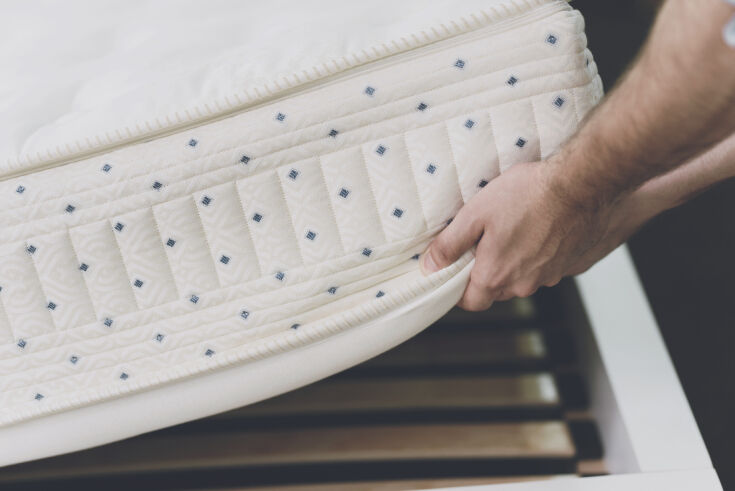

There is no one right thickness for a mattress. Its height is mostly comfort layers stacked on a support core, so a thicker mattress is not automatically more supportive or longer-lasting. What matters is how it is built and whether the finished bed fits your frame, your sheets and your body.
Support
Height alone does not add support. The core holds you up, and the layers above it set the feel. More on support
Fit
Your legs, frame, base, sheets and, for a bunk, the bed's own label set your height range. The fit checks
Durability
Materials, build, the base and care decide how long it holds up, not inches. What decides wear
Value
Pay for extra inches only when you can name what they are and feel the difference. How to decide
What the Inches Are Made Of
A mattress's height is its layers added together. Here is what each one does.
| Layer | What it does | What it adds to the height |
|---|---|---|
| Cover and quilting | Wraps the mattress. Quilting adds a little padding at the surface. | A thin top layer, a bit more when quilted |
| Pillow top or Euro-top | An extra padded layer sewn on top for more cushioning | Extra inches of softness, not support |
| Comfort layers | Foam, fiber or small coils that decide how the surface feels and how far you sink in | Often the biggest difference between a shorter and a taller model |
| Transition layer | Sits between the comfort layers and the core in some mattresses | Some height, when it is there at all |
| Support core | Coils, as in hybrid mattresses, or dense foam at the bottom. It does the main work of holding the body up. | The base of the stack |
- Cover and quilting
- Comfort layers
- Transition layer
- Support core
Two mattresses of the same height can be built very differently, which is why the height on the label tells you little on its own.
Does a Thicker Mattress Mean More Support?
Not by itself. The support core does the main work of holding your body up. The comfort layers above it decide how the surface feels. Extra inches can come from more comfort material or a pillow top rather than a stronger core, so a taller mattress may even feel softer.
That is why support comes first and height second. Mancini's Sleepworld's SleepMatch starts from support too. On the website it is a quiz; in store, at a SleepMatch location, it is a body scan whose color-coded report sorts you into Red for maximum support, Blue for more support, Green for medium support or Gold for less support and a plusher feel. None of those colors is a height, and mattresses at Mancini's Sleepworld at the same support level come in different heights, so settle support first and treat thickness as a separate choice.
How much cushioning you need on top depends on your body and position:
- Side sleepers press shoulders and hips into the surface and often like more cushioning there.
- Back and stomach sleepers often like less, so the hips do not sink further than the shoulders.
- Heavier bodies press further into the layers, so the firmer layers and core beneath matter more than the total height.
- The lying-down check: lie in your sleep position for several minutes. If you feel a firm layer pressing up at the shoulder or hip, the comfort layers are too thin or too soft for you. A lower mattress can still support well; this check shows whether its smaller room for cushioning matters to you.
If you have back or joint pain, that is a question for your doctor.
Fit Checks Before You Pick a Height
The height you live with is the whole bed: frame or platform, plus foundation or box spring, plus mattress, plus any topper. Run these checks before you fall for a number.
| Check | How to check it | If it does not fit |
|---|---|---|
| Getting in and out | Sit on the edge of the bed. A Texas A&M Health guide to bedroom safety for older adults says your feet should be firmly on the ground with your knees at a 90-degree angle. | Change the frame or foundation, or look at a taller or lower mattress. |
| Frame, headboard and nightstand | Add up every layer of the bed. A taller mattress covers more of the headboard and sits higher against a nightstand. | A different frame or foundation changes the total without changing the mattress. |
| Fitted sheets | Measure the mattress plus any topper or protector, then compare it with the pocket depth on the sheet label. | A taller mattress may need deeper-pocket bed sheets. |
| Platform, foundation or box spring | Check the mattress maker's base requirements. Many foam and hybrid mattresses are designed for a solid or slatted platform or foundation rather than a box spring with springs. | Listings for foundations at Mancini's Sleepworld show each foundation's height, and some are listed as low profile. Ask a Sleep Specialist which base a mattress needs and how tall the finished bed will be. |
| Adjustable base | Not every mattress is meant for an adjustable base. Check that both makers say they work together. | Compare adjustable bases and mattresses whose makers both say they pair. |
| Bunk, loft bed or trundle | Under federal safety rules, a bed with the bottom of its mattress foundation more than 30 inches above the floor counts as a bunk bed, so a loft bed built that high counts too. The top bunk's guardrails must reach at least 5 inches above the top of the mattress, and bunk beds must be labeled with the proper size and thickness of mattress. | Follow the bed's own label or instructions. For a trundle, daybed or other bed with a set space, check the bed maker's stated mattress height. |
| Carrying and rotating | Picture the stairs, turning the mattress, and lifting a corner to tuck in sheets. | A taller mattress is often heavier to handle. Weigh that against what the extra inches give you. |
Too low can be as hard as too high. In a small University of Utah pilot study, 12 adults over 55 with a range of strength and mobility limits got in and out of a hospital bed set at two heights, and half could not rise from the lower bed without help. If anyone in your home struggles to get in or out of bed, that is a question for their doctor.
Does a Thicker Mattress Last Longer?
Not because of its height. How long a mattress holds up depends on what the layers and core are made of, how they are built, the base underneath, and how it is used and cared for. Follow the maker's care instructions, such as rotating it if the maker says to.
The comfort layers near the top take pressure every night, so ask what they and the core are made of, not only how thick they are. The warranty terms for your mattress are on the warranty page.
Is a Thicker Mattress Worth Paying More For?
A taller mattress uses more material, which can raise the price, but price also reflects what the materials are, the coil unit, the brand and features such as a pillow top. This test tells you whether the extra inches are worth it to you:
- Measure at home first. Note your frame and base, how the current bed sits when you perch on the edge, and your sheets' pocket depth.
- Compare like for like. At a Mancini's Sleepworld location, one of 50+ locations across Northern California, ask a Sleep Specialist for two mattresses at the same support level in different heights. With many brands under one roof, you can try them from different brands side by side.
- Ask what the extra inches are made of. More comfort foam, fiber, small coils, a pillow top or a taller core each feel different.
- Lie on each in your sleep position for several minutes. Then sit on the edge and stand up.
- Buy the extra inches only if you felt a difference you would pay for. If you could not tell them apart, the shorter one may serve you just as well.
Where Your Situation Points Next
| If this is your situation | Your next move |
|---|---|
| Sitting on the edge of your current bed leaves your knees too high or too low | Change the frame or foundation first; it moves the total height without changing the mattress. If anyone struggles to get up, ask their doctor. |
| Your fitted sheets are already a tight stretch | Measure the mattress plus any topper and protector against the sheet's pocket depth before you choose a taller model. |
| You have an adjustable base, or plan to buy one | Shortlist only mattresses whose maker and the base maker both say they work together, then compare heights within that list. |
| The bed has a set space: a bunk, loft, trundle or daybed | The bed's own label or its maker's stated height sets the thickness. A lower mattress can still support well, so start there. |
| You felt a firm layer at the shoulder or hip on the lying-down check | Look for more comfort material above the core at the same support level, rather than more height for its own sake. |
| You want more cushion without a new mattress | A topper adds height and changes the surface feel, but it does not fix a sagging or worn-out mattress, and it adds to the depth your fitted sheet has to cover. Browse mattress toppers with that in mind. |
| You sleep warm and worry a taller bed will add to it | Height alone does not decide it. Ask what the layers near the surface are made of, look at your bedding and room, and lie still for several minutes before judging. |